Do Hybrids Have Catalytic Converters? Protect Against Catalytic Theft
Hybrid vehicles are popular for their impressive fuel economy and lower emissions. But many car owners and shoppers still ask a basic question:
Do hybrid cars have catalytic converters?
The answer is yes, and they play a crucial role in keeping hybrids clean, legal, and environmentally friendly. This guide explains how hybrid catalytic converters work, why they’re essential, how they differ from conventional cars, theft risks, maintenance, warranty coverage, and legal considerations.
Quick Answer
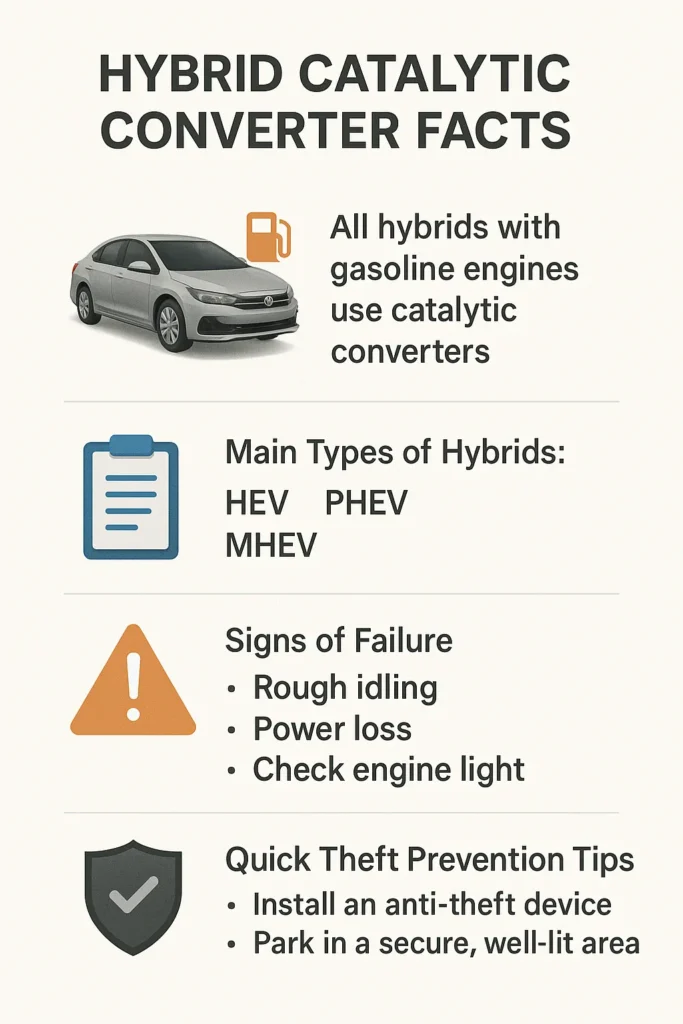
Yes. Nearly all hybrid vehicles that use a gasoline engine have a catalytic converter.
Whenever the engine runs, exhaust gases are produced and must be cleaned to meet emissions laws.
Do Hybrid Cars Have Catalytic Converters?
Yes—almost every hybrid car on the road today has a catalytic converter.
Hybrid vehicles such as the Toyota Prius, Honda Accord Hybrid, Ford Fusion Hybrid, and most plug-in hybrids still rely on a gasoline engine for part of their operation. Whenever that engine runs—whether to move the car or charge the battery—it produces exhaust gases. A catalytic converter is required to treat those gases before they exit the tailpipe.
Hybrid vs Electric vs Fuel-Cell: Which Vehicles Have Catalytic Converters?
This is where many drivers get confused.
- Hybrid vehicles (HEV, PHEV): ✅ Yes — they have gasoline engines and exhaust systems
- Battery electric vehicles (BEV): ❌ No — they produce no exhaust
- Hydrogen fuel-cell vehicles (FCEV): ❌ No traditional catalytic converter (they emit mostly water vapor)
If a vehicle has no exhaust system, it does not need a catalytic converter. Any vehicle that burns gasoline—even part-time—does.
Why Do Hybrids Need Catalytic Converters?
Even though hybrids are cleaner than traditional cars, emissions laws still apply.
Hybrids need catalytic converters because:
- Emissions regulations: Any gasoline engine must control exhaust pollution
- Exhaust production: The engine creates emissions whenever it runs
- Cleaner operation: The converter minimizes pollution even during short engine cycles
Without a catalytic converter, a hybrid would immediately fail emissions testing and be illegal to drive.
When Does the Catalytic Converter Work on a Hybrid?
Hybrid engines frequently shut off during:
- Low-speed driving
- Coasting
- Idling at traffic lights
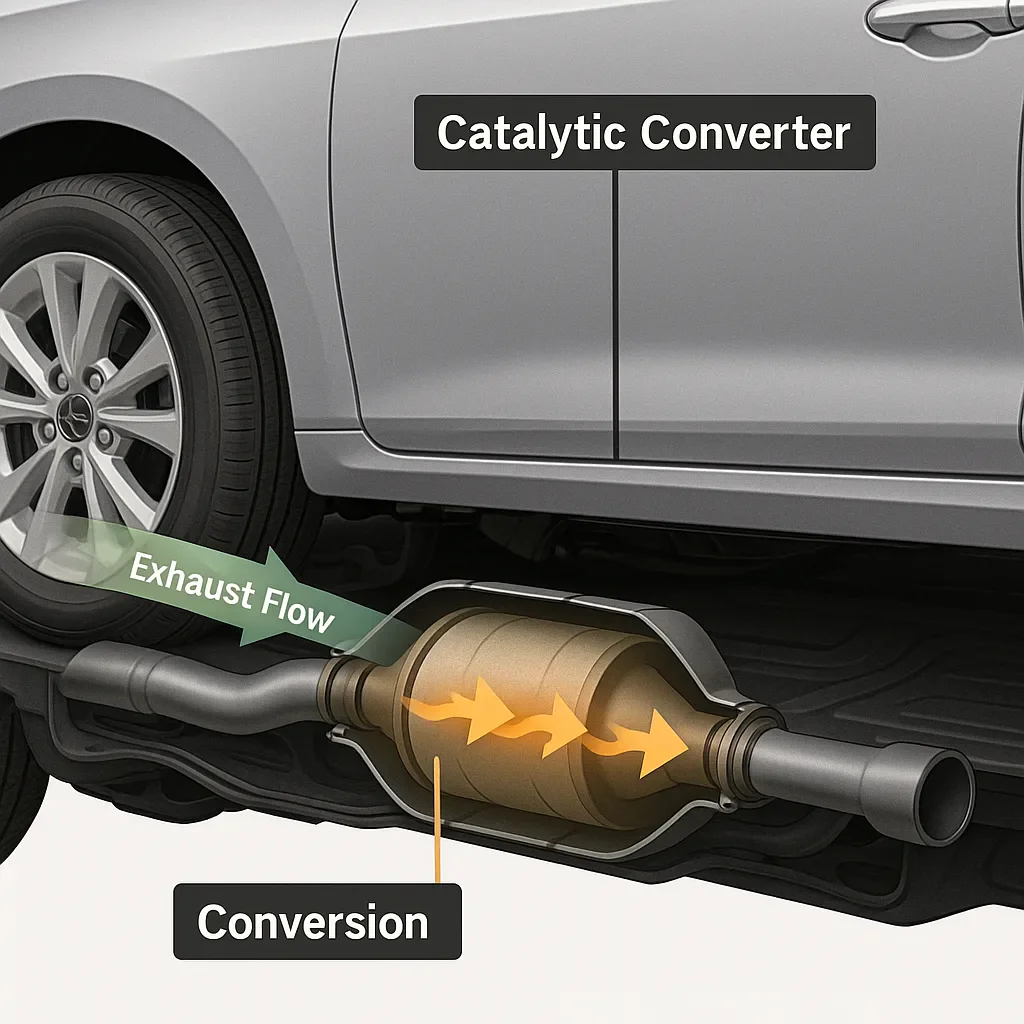
During these moments, there are zero emissions. But when the engine restarts, emissions spike instantly. The catalytic converter must become effective almost immediately.
Cold Starts and “Light-Off” Temperature: Why Hybrids Are Different
A catalytic converter only works once it reaches a certain heat level called light-off temperature.
In hybrids:
- The engine turns on and off frequently
- The converter cools down between cycles
- Reheating must happen very quickly
To solve this, manufacturers use:
- Converter placement close to the engine
- Insulation and heat retention
- Electrically heated catalysts (on some models)
- Higher precious-metal loading
This is one reason hybrid converters are more complex—and more valuable—than conventional ones.
How Are Hybrid Catalytic Converters Different from Conventional Ones?
Operating Temperature
- More frequent engine shutdowns
- Faster warm-up required
Precious Metal Content
- Higher platinum, palladium, and rhodium levels
- Better low-temperature performance
- Higher scrap value
Durability
- Less total engine run time can extend lifespan
- Frequent cooling may increase condensation risk
Are Hybrid Catalytic Converters at Higher Risk for Theft?
Yes. Hybrids are among the most targeted vehicles for catalytic converter theft.
Thieves target hybrids because:
- Converters contain higher precious-metal concentrations
- They stay cleaner due to reduced engine use
- Many hybrids have easy under-vehicle access
- Resale value on the black market is high
Are Some Hybrid Models Targeted More Than Others?
Yes. Theft risk can vary by:
- Model popularity (high-volume hybrids are targeted more)
- Vehicle height (easier access underneath)
- Model year (older designs often lack shields)
This is why certain Prius generations, for example, are stolen more often than newer designs.
How to Protect Your Hybrid’s Catalytic Converter
- Park in a garage or well-lit area
- Install a catalytic-converter shield or cage
- Etch your VIN on the converter
- Add an alarm or tilt sensor
- Confirm comprehensive insurance coverage
Types of Hybrids and Catalytic Converter Requirements
| Vehicle Type | Gas Engine | Catalytic Converter | Examples | Notes |
|---|---|---|---|---|
| Full Hybrid (HEV) | Yes | Yes | Toyota Prius, Ford Escape | Engine + motor work together |
| Plug-in Hybrid (PHEV) | Yes | Yes | Prius Prime, Chevy Volt | Engine runs less often |
| Mild Hybrid (MHEV) | Yes | Yes | Honda Insight, Ram eTorque | Engine always active |
| Series Hybrid | Yes | Yes | BMW i3 REx | Engine charges battery |
| Battery EV (BEV) | No | No | Tesla Model 3 | No exhaust system |
| Fuel Cell (FCEV) | No | No | Toyota Mirai | Hydrogen system |
Why Hybrids Still Need Catalytic Converters
Even short engine run times can produce harmful emissions.
With a catalytic converter:
- CO, HC, and NOx emissions are reduced dramatically
- Vehicles stay within legal limits
- Air quality is protected
Without one, hybrids would lose their environmental advantage.
Do Hybrids Use the Catalytic Converter When Driving on Electric Power?
No exhaust is produced when the gasoline engine is off.
However, the catalytic converter must still be present and functional because:
- The engine can restart at any time
- Emissions spike instantly on restart
- Sensors constantly monitor the system
Electric-only driving does not eliminate the need for a catalytic converter.
Signs of a Bad Catalytic Converter in a Hybrid
- Check engine light (P0420 / P0430)
- Rotten-egg or sulfur smell
- Sluggish acceleration
- Failed emissions test
- Rattling noise under the car
- Excessive heat underneath
What Causes Hybrid Catalytic Converters to Fail?
- Engine misfires sending unburned fuel
- Oil or coolant leaks contaminating the catalyst
- Constant short trips preventing self-cleaning
- Ignored sensor or ignition problems
Can You Drive a Hybrid Without a Catalytic Converter?
No. Driving without one is illegal in most regions and can lead to:
- Immediate inspection failure
- Heavy fines
- Engine damage
- Limp-mode operation
Will a Hybrid Fail Inspection Without a Catalytic Converter?
Yes. A missing or failed catalytic converter will:
- Trigger warning lights
- Fail emissions testing instantly
- Make the vehicle illegal to drive
Are Hybrid Catalytic Converters Covered Under Warranty?
Yes. Hybrid catalytic converters are typically covered under the federal emissions warranty (for example, 8 years or 80,000 miles in the U.S.).
This coverage applies to defects—not theft or physical damage.
Aftermarket vs OEM Catalytic Converters for Hybrids (CARB vs EPA)
- Some states require CARB-certified converters
- Not all aftermarket converters are legal everywhere
- Using the wrong part can cause inspection failure
Always confirm emissions compliance before replacement.
What Happens If a Hybrid’s Converter Is Stolen?
- Extremely loud exhaust
- Check engine light
- Vehicle becomes illegal to drive
- Replacement costs often $1,500–$3,000+
Conclusion
Yes—hybrid vehicles do have catalytic converters, and they are essential. Even though hybrids rely heavily on electric power, their gasoline engines still produce emissions that must be controlled.
Catalytic converters help hybrids remain clean, legal, and environmentally friendly. Protecting this component from theft and maintaining your engine properly ensures long-term efficiency and compliance.