What Is a Pre Catalytic Converter?

When your car is running normally, your main catalytic converter handles most of the exhaust treatment. But in the first 60–90 seconds after a cold start — before that main converter reaches operating temperature — your engine is producing its dirtiest, most unfiltered emissions. The pre-catalytic converter exists to solve exactly that problem.
A pre-cat is a compact, fast-heating emissions device mounted close to the engine. It typically reaches its light-off temperature of around 150–250 °C within 20–30 seconds of ignition, while the main converter is still warming up. That early activation is the difference between passing a modern emissions test and failing it.
This guide covers how a pre-cat works, how it differs from your main converter, what failure looks like, and whether your vehicle actually has one.

What is a Pre Catalytic Converter?
A pre-catalytic converter — also called a pre-cat, header cat, or manifold cat — is a first-stage emissions control device installed directly on or near the exhaust manifold. It works as the opening act of your exhaust treatment system, intercepting and converting harmful gases before they reach the main catalytic converter further down the pipe.
The pre-cat is smaller and less thermally massive than the main converter, which is precisely the point. Less mass means faster heat-up, and faster heat-up means emissions control begins within seconds rather than minutes. In modern vehicles engineered to meet U.S. EPA or European Euro 5/6 standards, this early activation is not optional — without it, cold-start emissions would push the vehicle over legal limits before the main converter ever came online.
Pre-Cat vs. Main Catalytic Converter: Key Differences
| Feature | Pre-Catalytic Converter | Main Catalytic Converter |
|---|---|---|
| Location | At or near the exhaust manifold | Further down the exhaust system |
| Size | Compact | Larger and more robust |
| Light-off temperature | 150–250 °C | 300–400 °C |
| Warm-up time | 20–30 seconds | 2–3 minutes |
| Primary role | Cold-start emissions control | Emissions during normal driving |
| Typical lifespan | 70,000–100,000 miles | 100,000–150,000 miles |
| Common failure modes | Melting, substrate collapse, clogging | Efficiency loss, clogging |
| Typical part cost | $300–$1,000 | $900–$2,500 |
The shorter lifespan of a pre-cat comes down to its operating conditions — it runs hotter than the main converter and processes exhaust gases that are still dirty and incompletely combusted. Those harsher conditions wear it out faster.
How a Pre-Catalytic Converter Works
Position in the Exhaust System
Raw exhaust gas exits the combustion chamber, passes through the exhaust manifold, and immediately encounters the pre-cat. Because of this close proximity to the engine, the pre-cat absorbs heat rapidly — reaching functional temperature within 20–30 seconds of a cold start, while the main converter, sitting further down a longer pipe, is still cold.
During those first few minutes, the pre-cat is the only active emissions control device on the vehicle. This is the window when unregulated emissions would otherwise spike.
The Three-Way Catalytic Reaction
Inside the pre-cat is a ceramic honeycomb substrate coated with three precious metals — platinum, palladium, and rhodium — each targeting a different class of pollutant. This configuration is called a three-way catalyst, and it handles all three major exhaust gases simultaneously.
Platinum and palladium oxidize carbon monoxide and unburned hydrocarbons:
2 CO + O₂ → 2 CO₂
C₃H₈ + 5 O₂ → 3 CO₂ + 4 H₂O
Rhodium reduces nitrogen oxides under rich exhaust conditions:
2 NOx → x O₂ + N₂
None of these metals are consumed in the process — they act as catalysts, meaning they trigger and accelerate the reactions without being chemically altered. This is why a well-maintained pre-cat can last the better part of a decade despite running continuously.
Why the Pre-Cat Matters for Emissions Compliance
Cold starts are responsible for a disproportionate share of a vehicle’s total lifetime emissions. Studies consistently show that the first two to three minutes of operation generate more CO, HC, and NOx than hours of steady highway driving — because the entire exhaust system is cold, the engine runs rich, and the main catalytic converter is inactive.
Pre-cats are what allow modern vehicles to meet:
- United States (EPA Tier 3): Strict limits on CO, HC, NOx, and particulate matter across the full drive cycle, including cold start
- Europe (Euro 5 and Euro 6): Ultra-low emissions requirements that are effectively impossible to meet without cold-start treatment
- Other frameworks: Japan (Post New Long-Term), India (Bharat Stage VI), and China (China 6) all impose similar cold-start provisions
Without a functioning pre-cat, many modern vehicles would fail emissions testing — particularly during short urban trips where the main converter never fully warms up.
Recyclability
Pre-cats contain the same recyclable precious metals as main converters — platinum, palladium, and rhodium. At end of life, these materials are recovered and re-enter the supply chain. The precious-metal content also explains why catalytic converter theft, including pre-cats, remains a persistent problem in many regions.
Impact on Engine Performance
Backpressure
Because exhaust gases pass through the pre-cat immediately after leaving the combustion chamber, the device does create some backpressure. In stock, normally aspirated engines, this is typically in the range of 0.1–0.3 PSI — negligible in everyday driving. The effect becomes more noticeable in forced-induction or high-revving performance engines, where exhaust flow rates are higher and backpressure has a measurable effect on power output.
Manufacturers balance this trade-off during development by choosing substrate cell densities (cells per square inch) that provide adequate emissions control without excessive restriction.
Modifications and Removal
Some performance enthusiasts consider removing or bypassing the pre-cat to improve exhaust flow. On modern vehicles, this creates consequences beyond the obvious legal ones. The engine control unit monitors catalyst performance through a pair of oxygen sensors — one upstream, one downstream of each catalyst. With the pre-cat removed, the upstream sensor reads conditions the ECU doesn’t expect, causing fuel-trim errors that can actually reduce performance rather than improve it.
For regulated markets, removing any catalytic converter is an illegal tampering with emissions equipment and will result in immediate failure of any emissions inspection.
A more practical alternative for performance applications is a high-flow pre-cat — same precious-metal chemistry, less restrictive substrate geometry — which recovers most of the airflow benefit without triggering sensor faults or regulatory violations.
Do All Vehicles Have a Pre-Cat?
No. Pre-cats are most common in:
- Gasoline-powered vehicles built for the U.S. or European markets, particularly those produced after 2000
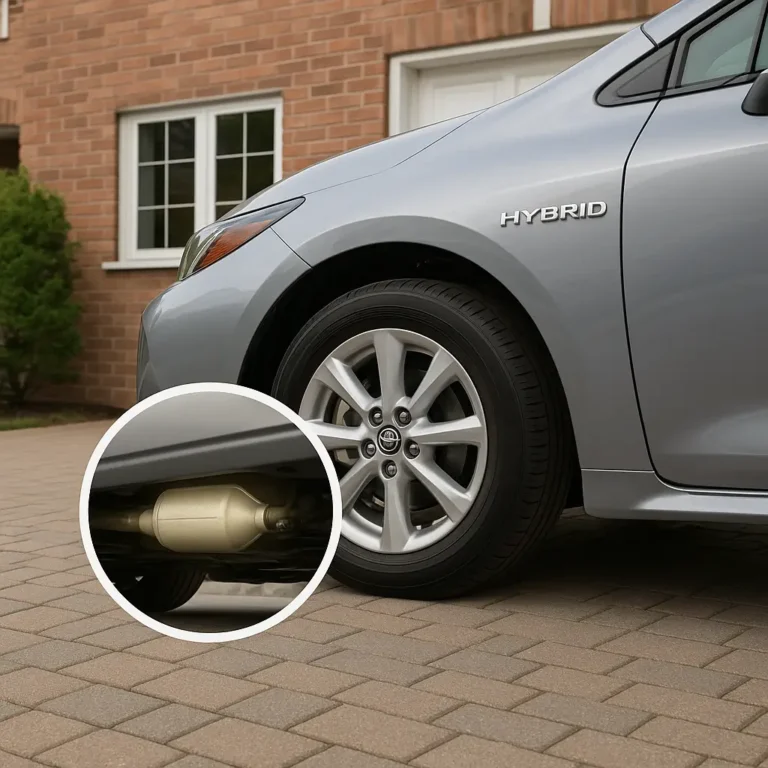
- Hybrid vehicles, which face particular cold-start challenges due to frequent engine on/off cycling (the Toyota Prius system is a well-documented example)
- Turbocharged engines in high-emission-standard markets, where the turbocharger’s position complicates exhaust routing and makes an early catalyst especially valuable
Older vehicles, diesel engines (which use a different emissions-control architecture), and vehicles built for markets with less stringent regulations typically use only a single main catalytic converter.
To confirm whether your vehicle has a pre-cat, check the OBD-II scan data for multiple catalyst monitor readings, consult the factory service manual, or physically inspect the exhaust near the manifold.

Common Problems and How to Diagnose Them
How OBD-II Monitoring Works
Modern vehicles track catalyst efficiency continuously. The ECU compares the oxygen sensor reading upstream of the catalyst to the one downstream. A healthy catalyst consumes oxygen during the conversion process, so the two sensors should read differently. When the downstream sensor begins mirroring the upstream reading — meaning the catalyst isn’t converting anything — the ECU logs a fault.
- P0420 — Catalyst system efficiency below threshold, Bank 1
- P0430 — Catalyst system efficiency below threshold, Bank 2
These codes can indicate failure in either the pre-cat or the main converter. Distinguishing between them requires checking which oxygen sensor pair is out of spec — a step that many quick-lube shops skip, leading to unnecessary main converter replacements when the pre-cat is the actual fault.
Symptoms of Pre-Cat Failure
Beyond the check engine light, the signs worth watching for are:
Sluggish acceleration from a cold start — the most telling symptom. If the car feels noticeably underpowered in the first minute of driving but improves once the engine is warm, the pre-cat is a strong candidate.
Sulfur or rotten-egg smell — especially noticeable on cold mornings, caused by unprocessed hydrogen sulfide in the exhaust.
Rattling from the exhaust — a collapsed or cracked substrate causes a distinctive metallic rattle that is loudest when cold and often quiets as the metal expands with heat. This distinguishes it from heat shield rattles, which behave the opposite way.
Failed emissions test — particularly if the failure is flagged during the cold portion of the test cycle.
Why You Shouldn’t Delay Repairs
A deteriorating pre-cat that begins shedding ceramic substrate fragments poses a direct risk to the main converter downstream. Those fragments can partially block the main cat’s substrate, reducing its efficiency and eventually destroying it. What starts as a $500 pre-cat replacement becomes a $2,000+ job if the main converter is also damaged. Early diagnosis is worth the diagnostic fee.
Replacement Costs and Options
Part costs for a pre-cat typically fall between $300 and $1,000 depending on the vehicle make, model, and whether the pre-cat is sold as a standalone unit or integrated with the exhaust manifold as a single assembly. When it’s integrated — common on many European and Japanese vehicles — labor costs rise significantly because the manifold must be removed as part of the job.
Aftermarket pre-cats are widely available and are meaningfully cheaper than OEM parts, but they vary in quality. For vehicles that need to pass emissions inspections, ensure any aftermarket unit carries the appropriate CARB (California Air Resources Board) or EPA exemption designation for your state. A non-compliant aftermarket unit may pass visually but fail the efficiency monitor.
Maintenance Tips to Extend Pre-Cat Life
- Fix engine misfires immediately — raw fuel reaching the catalyst causes rapid overheating and substrate damage
- Use the correct fuel grade; consistent lean or rich running conditions accelerate catalyst degradation
- Replace oxygen sensors on schedule; a failing O2 sensor can cause fuel-trim errors that overheat the pre-cat
- Inspect the exhaust manifold gasket periodically — an exhaust leak upstream of the pre-cat introduces uncontrolled oxygen and disrupts the three-way conversion chemistry
Frequently Asked Questions
How do I know if my car has a pre-cat?
Connect an OBD-II scanner and check for multiple catalyst monitor readings. You can also inspect the exhaust physically — look for a smaller converter body close to the exhaust manifold, separate from the larger main converter further down the pipe. Your vehicle’s service manual will confirm the exact configuration.
Can I drive with a bad pre-cat?
Short-term, yes — the main converter partially compensates. But a substrate that’s beginning to collapse will shed ceramic debris that can block and destroy the main converter downstream. A pre-cat problem caught early is a fraction of the cost of one left to run.
How long does a pre-cat last?
Typically 70,000–100,000 miles, shorter than the main converter’s 100,000–150,000 mile range. The harsher operating environment — higher temperatures, dirtier exhaust — wears it out faster.
Is a pre-cat the same as a header cat?
Yes. Header cat, manifold cat, and pre-cat all refer to the same device. The name varies by where it’s mounted and who’s doing the naming.
Why is pre-cat replacement so expensive on some vehicles?
When the pre-cat is integrated into the exhaust manifold as a single casting — common on many European vehicles — replacing it means replacing the manifold too. That drives both part and labor costs well above what a standalone unit would cost.
Will removing my pre-cat improve performance?
Rarely, and not without consequences. On modern engine management systems, removing the pre-cat upsets the oxygen sensor readings the ECU depends on for fuel trim calculations. The resulting fuel delivery errors typically negate any flow benefit, and the modification is illegal for road use in most markets.
The Bottom Line
Pre-catalytic converters do their most important work in a window most drivers never think about — the first 30–60 seconds after a cold start, when the main converter is still cold and emissions are at their peak. If yours is failing, the first signal is usually a P0420 or P0430 fault code, often paired with sluggish cold-start performance or a sulfur smell on cold mornings.
Act on those signals early. A degraded pre-cat that begins shedding substrate debris will eventually damage the main converter downstream, multiplying the repair bill. If you’re buying a used vehicle, a pre-cat inspection belongs on the pre-purchase checklist — and if you’re chasing a fault code, confirm which catalyst the sensors are flagging before authorizing any replacement. The diagnosis