
Catalytic Converter vs Carburetor: Which Should You Choose?

Catalytic converter vs carburetor is a common comparison for anyone curious about how vehicles manage fuel delivery and emissions. The confusion is especially common among classic car owners and enthusiasts restoring older vehicles, where both terms often appear in manuals, inspections, or mechanic discussions.
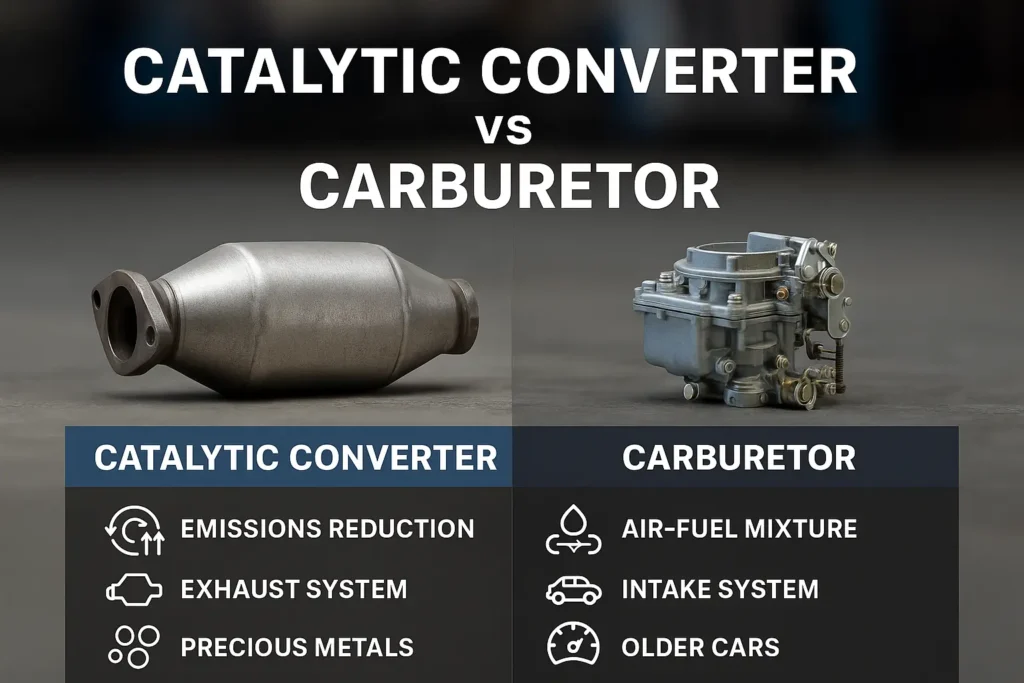
Although they’re sometimes mentioned together, these two components do completely different jobs. A carburetor controls how fuel enters the engine, while a catalytic converter cleans exhaust gases after combustion. Understanding their differences helps you make better decisions about repairs, upgrades, and legal compliance—especially when dealing with emissions testing or classic vehicles.
What Is a Catalytic Converter?
A catalytic converter is an emissions-control device located in the exhaust system of modern vehicles. Its job is to reduce harmful gases before they exit the tailpipe.
Inside the converter is a ceramic honeycomb coated with precious metals such as platinum, palladium, and rhodium. When hot exhaust gases pass through, chemical reactions convert toxic pollutants into safer emissions:
- Carbon monoxide (CO) → Carbon dioxide (CO₂)
- Nitrogen oxides (NOx) → Nitrogen + oxygen
- Unburned hydrocarbons → Water vapor + carbon dioxide
👉 In short, the catalytic converter helps vehicles meet emissions laws and keeps the air cleaner.
If you’re comparing exhaust parts, you may also want to read catalytic converter vs muffler for a clearer system-level overview.
What Is a Carburetor?
A carburetor is a fuel-delivery system used in older vehicles, motorcycles, and small engines. Its role is to mix air and fuel in the correct ratio before the mixture enters the engine cylinders.
Carburetors work using vacuum and air pressure differences. As air flows through the venturi, fuel is drawn from the fuel bowl and atomized into a combustible mixture.
Key functions of a carburetor include:
- Mixing air and fuel correctly
- Adjusting fuel flow for idling and acceleration
- Delivering fuel consistently to keep the engine running
👉 Modern vehicles no longer use carburetors. Since the 1990s, electronic fuel injection has replaced them due to better efficiency, reliability, and emissions control.
Catalytic Converter vs. Carburetor
| Feature | Catalytic Converter | Carburetor |
|---|---|---|
| Main Job | Reduce exhaust emissions | Mix air and fuel |
| Location | Exhaust system | Intake system |
| Key Components | Ceramic honeycomb + precious metals | Venturi, jets, throttle plate, fuel bowl |
| Output | Cleaner exhaust gases | Combustible air-fuel mixture |
| Used In | All modern vehicles | Pre-1990s cars, small engines |
| Environmental Role | Reduces smog and harmful gases | None directly |
As you can see, one manages pollution, while the other manages fuel delivery.
Why Was the Carburetor Important in Older Cars?
Before fuel injection systems existed, carburetors were the standard method of supplying engines with the correct air-fuel mixture. They were mechanical, simple, and easy to repair.
Advantages of carburetors
- Simple design
- Easy to repair with basic tools
- Low manufacturing cost
Limitations
- Lower fuel efficiency
- Susceptible to flooding
- Required frequent tuning
Because of these drawbacks, manufacturers phased out carburetors in favor of electronically controlled fuel injection systems.
Key Differences Between a Catalytic Converter and Carburetor
Purpose
- Catalytic Converter: Reduces harmful exhaust emissions
- Carburetor: Mixes fuel and air for combustion
Location
- Catalytic Converter: Exhaust system
- Carburetor: Intake system
Impact
- Catalytic Converter: Environmental protection and legal compliance
- Carburetor: Engine performance and drivability
Relevance Today
- Catalytic Converter: Still required and widely used
- Carburetor: Mostly obsolete in modern vehicles
Do Modern Cars Have Both?
No.
Modern cars use fuel injection + catalytic converters. Carburetors are no longer used in modern passenger vehicles.
If your car was built after the 1990s:
- ✅ You have a catalytic converter
- ❌ You do not have a carburetor
Can a Car Run Without a Catalytic Converter or Carburetor?
Without a catalytic converter:
Technically yes, but it’s illegal in most regions. The car will pollute more, fail emissions tests, and likely trigger warning lights.
Without a carburetor:
Older vehicles cannot run. Modern vehicles don’t use carburetors at all.
Why Are Catalytic Converters More Expensive Than Carburetors?
Catalytic converters are expensive because they contain rare precious metals, especially rhodium, which is among the most valuable metals in the world.
Carburetors are typically made from aluminum and brass, making them far cheaper to manufacture and replace.
That’s why:
- Carburetors were once affordable repairs
- Catalytic converter replacement today can cost $1,000–$3,000+
For replacement decisions, see OEM vs aftermarket catalytic converters.
Which One Affects Vehicle Performance More?
- Carburetor (or fuel system): Directly affects throttle response, power, and fuel economy
- Catalytic Converter: Mainly affects emissions; performance drops only if it becomes clogged
👉 Performance = fuel system
👉 Emissions compliance = catalytic converter
Which Is More Commonly Replaced Today?
- Catalytic Converter: Frequently replaced due to clogging, damage, or theft
- Carburetor: Rarely replaced except on classic cars and small engines
Catalytic converter theft has increased dramatically due to precious metal prices. According to the National Insurance Crime Bureau, theft incidents rose by over 1,000% between 2018 and 2022.
Real-Life Example: Classic Car vs Modern Car
- 1970s Chevy Impala: Uses a carburetor; early models lacked catalytic converters
- 2023 Toyota Corolla: Uses fuel injection and a catalytic converter, with no carburetor
This shift highlights how automotive technology evolved from mechanical simplicity to emissions control.
Final Thoughts
The catalytic converter and carburetor may sound similar, but they serve entirely different purposes. Carburetors control fuel delivery in older engines, while catalytic converters reduce harmful exhaust emissions in modern vehicles.
If you drive a modern car, maintaining a healthy catalytic converter is essential.
If you own a classic vehicle, proper carburetor tuning matters just as much.
Together, these components reflect the evolution of automobiles—from mechanical efficiency to environmental responsibility.


