
Catalytic Converter vs Exhaust
Catalytic converter vs exhaust is a common comparison for car owners trying to understand emissions problems, inspection failures, or exhaust repairs. These terms are often used interchangeably, which leads to confusion, unnecessary repairs, and wasted money.
In simple terms, a catalytic converter is one specific part of the exhaust system that cleans emissions, while the exhaust system is the complete network that carries gases away from the engine, reduces noise, and keeps the vehicle safe and legal. Understanding this difference helps you diagnose problems correctly and make smarter repair decisions.
What Is a Catalytic Converter?
A catalytic converter is a specialized emissions-control device installed within the exhaust system. Its main job is to convert harmful exhaust gases into less harmful substances before they exit the tailpipe.
It targets pollutants such as:
- Carbon monoxide (CO)
- Nitrogen oxides (NOx)
- Unburned hydrocarbons
Inside the converter is a honeycomb structure coated with platinum, palladium, and rhodium. These precious metals act as catalysts, triggering chemical reactions that convert pollutants into carbon dioxide (CO₂), nitrogen (N₂), and water vapor (H₂O).
Location: Between the exhaust manifold and the muffler
Legal requirement: Mandatory on all modern vehicles
Common failure signs: Check engine light, rattling noise, reduced performance, failed emissions tests
To understand how emissions control differs from noise reduction, see our guide on catalytic converter vs muffler.
What Is an Exhaust System?
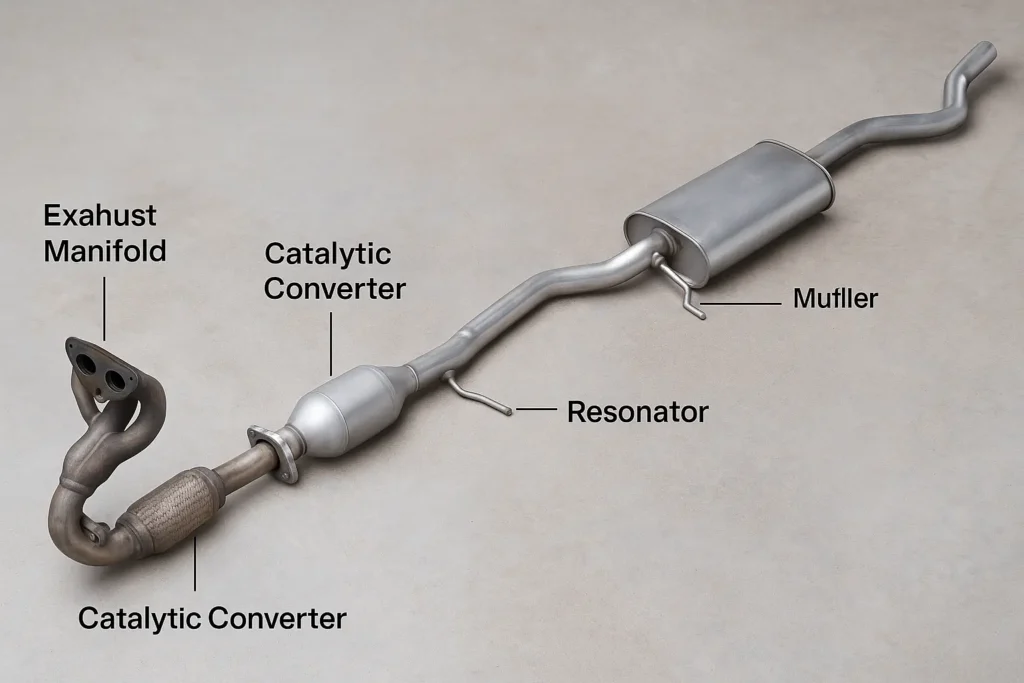
The exhaust system is the complete assembly of components that safely guide exhaust gases from the engine to the outside of the vehicle. It also reduces noise, supports emissions control, and prevents fumes from entering the cabin.
Typical exhaust system components include:
- Exhaust manifold
- Oxygen sensors
- Catalytic converter
- Resonator (on some vehicles)
- Muffler
- Exhaust pipes and tailpipe
While the catalytic converter focuses on cleaning emissions, the exhaust system as a whole manages gas flow, noise reduction, safety, and compliance.
How Does a Catalytic Converter Work?
The catalytic converter works by forcing hot exhaust gases through its catalyst-coated honeycomb. At high temperatures, chemical reactions occur that break down pollutants:
- Carbon monoxide → Carbon dioxide
- Nitrogen oxides → Nitrogen + oxygen
- Hydrocarbons → Carbon dioxide + water vapor
Because this process requires heat, the converter is placed close to the engine where exhaust temperatures are highest.
How Does the Exhaust System Work?
The exhaust system begins at the exhaust manifold, which collects gases from the engine cylinders. These gases then flow through:
- The catalytic converter (emissions treatment)
- The resonator and muffler (noise reduction)
- The tailpipe (safe release outside the vehicle)
A properly functioning exhaust system keeps the engine efficient, the cabin safe, and the vehicle quiet.
What’s the Key Difference Between a Catalytic Converter and Exhaust?
- A catalytic converter is a single emissions-control component.
- The exhaust system is the entire network of parts that manage exhaust gases—including the catalytic converter.
Think of the catalytic converter as one specialist on a team, while the exhaust system is the entire team working together.
Why Are Both Important?
- Emissions control: The catalytic converter is essential for reducing pollution.
- Performance & safety: The exhaust system prevents fumes from entering the cabin and supports smooth engine operation.
- Legal compliance: Missing or damaged components can cause failed emissions or safety inspections.
If you’re considering exhaust modifications, read catalytic converter vs straight pipe to understand the legal and performance risks.
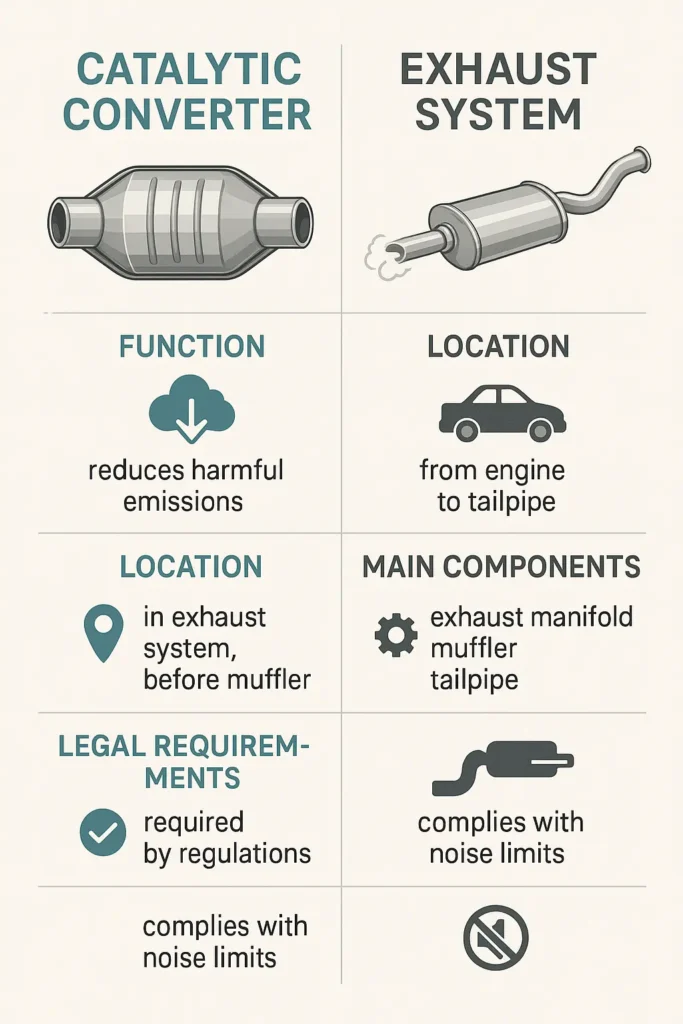
| Feature | Catalytic Converter | Exhaust System |
|---|---|---|
| Main Function | Converts harmful gases | Routes gases, reduces noise & emissions |
| Location | Between manifold & muffler | Engine to tailpipe |
| Contains | Precious metal catalyst | Manifold, converter, pipes, muffler, sensors |
| Legal Requirement | Yes (modern vehicles) | Yes |
| Failure Symptoms | Check engine light, poor emissions | Loud noise, fumes, vibration |
What Happens If You Remove the Catalytic Converter?
Removing the catalytic converter is illegal in most regions and can cause:
- Increased exhaust noise
- Higher emissions
- Check engine lights
- Failed inspections and possible fines
It may also damage oxygen sensors and affect engine performance.
How Do You Know If You Have a Problem?
Catalytic Converter Problems
- Check engine light (codes like P0420 or P0430)
- Rotten-egg or sulfur smell
- Rattling under the vehicle
- Failed emissions tests
Exhaust System Problems
- Excessive noise
- Vibrations
- Reduced power
- Exhaust fumes inside the car
Should You Replace the Catalytic Converter or the Whole Exhaust?
IIt depends on the diagnosis:
- If only the converter has failed, replacing just that part is often enough.
- If pipes, muffler, or manifold are rusted or leaking, replacing sections—or the full exhaust—may be necessary.
Many catalytic converter failures are actually caused by upstream exhaust leaks or engine issues, so proper diagnosis is essential before replacement.
Conclusion
While the terms are often confused, the catalytic converter is a specific emissions device, and the exhaust system is the complete assembly that manages all exhaust gases. Both are essential for performance, safety, legal compliance, and environmental protection.
Knowing whether a problem lies in the catalytic converter or the exhaust system helps you fix the right part, avoid unnecessary repairs, and stay legal on the road. If you notice warning signs, a professional inspection can save you money and prevent bigger issues later.