Catalytic Converter vs Downpipe: Which Boosts Power?
Many drivers struggle to decide between upgrading a catalytic converter or a downpipe. Choosing the wrong option can lead to failed emissions tests, check-engine lights, tuning problems, or wasted money with little performance gain.
The confusion usually comes from the fact that these parts sit close together and sometimes even overlap in design. In this guide, we’ll clearly break down catalytic converter vs downpipe, explain how each affects performance and legality, and help you choose the best option for your driving goals.
What Is a Catalytic Converter?
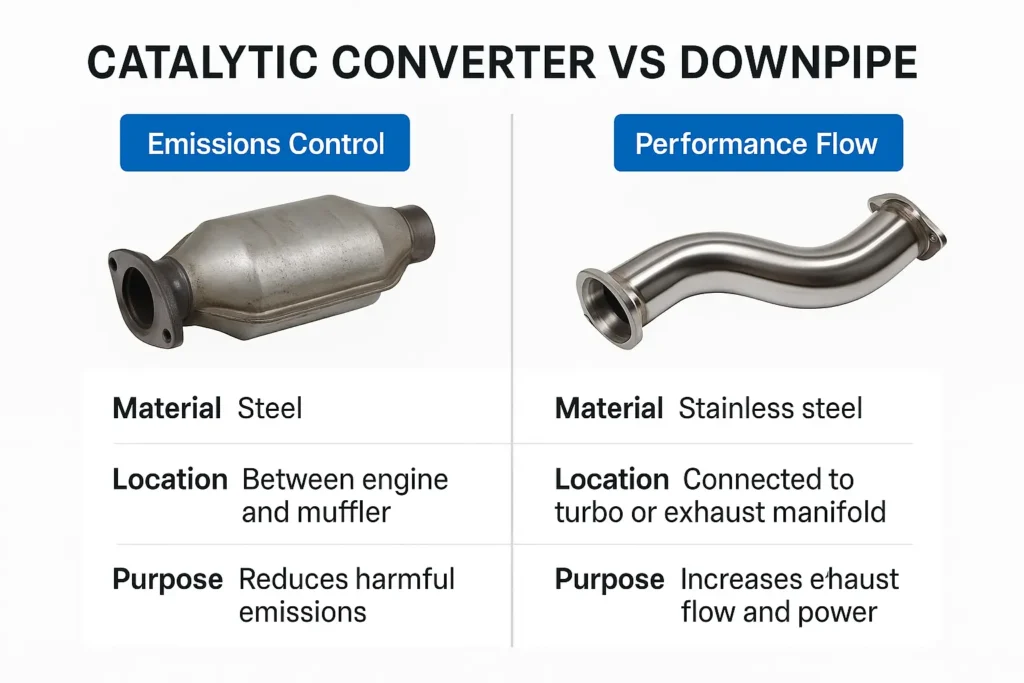
A catalytic converter is an emissions-control device installed in your vehicle’s exhaust system. Its purpose is to convert harmful exhaust gases into less harmful substances before they exit the tailpipe.
Key details:
- Function: Reduces pollutants like carbon monoxide (CO), nitrogen oxides (NOx), and hydrocarbons
- Location: Between the exhaust manifold or turbo and the muffler (sometimes integrated into the downpipe)
- How it works: Uses precious metals such as platinum, palladium, and rhodium to trigger chemical reactions
Catalytic converters are legally required on all modern street-driven vehicles. Driving without one is illegal in most regions and often results in failed inspections and fines.
For emissions-focused decisions, you may also want to read catalytic converter vs muffler to understand noise vs emissions control.
What Is a Downpipe?
A downpipe is a section of exhaust piping that connects the turbocharger (or exhaust manifold on non-turbo cars) to the rest of the exhaust system.
Key details:
- Function: Routes exhaust gases away from the turbo or manifold
- Location: Bolted directly to the turbo outlet or exhaust manifold
- Common types:
- Catted downpipe (includes a catalytic converter)
- Catless downpipe (no catalytic converter)
Downpipes are especially important in turbocharged vehicles, because the first exhaust section after the turbo has a major impact on exhaust flow, turbo spool, and power delivery.
What’s the Role of the Downpipe in Performance Upgrades?
Upgrading the downpipe is one of the most common modifications for turbocharged cars.
Catless downpipes
- Maximum exhaust flow
- Faster turbo spool
- Largest horsepower gains
- ❌ Not street-legal in most areas
High-flow catted downpipes
- Reduced backpressure
- Better performance than stock
- Retains emissions control
- ✅ More street-friendly
Depending on the car and supporting mods, upgrading a restrictive stock downpipe can result in 10–40 horsepower gains, especially when paired with a tune.
For legality concerns, compare this with catalytic converter vs straight pipe to understand where downpipes fit in the exhaust spectrum.
Catalytic Converter vs Downpipe: At a Glance
| Feature | Catalytic Converter | Downpipe |
|---|---|---|
| Main Purpose | Reduce harmful emissions | Route exhaust gases |
| Affects Emissions | Yes (required for compliance) | Only if it includes a catalytic converter |
| Performance Impact | Adds some backpressure | Catless = max flow, catted = balanced |
| Typical Location | After manifold or turbo | Directly after turbo/manifold |
| Legal Requirement | Mandatory for street use | Legal only if emissions-compliant |
| Typical Cost | $100–$2,000+ | $150–$1,000+ (catted costs more) |
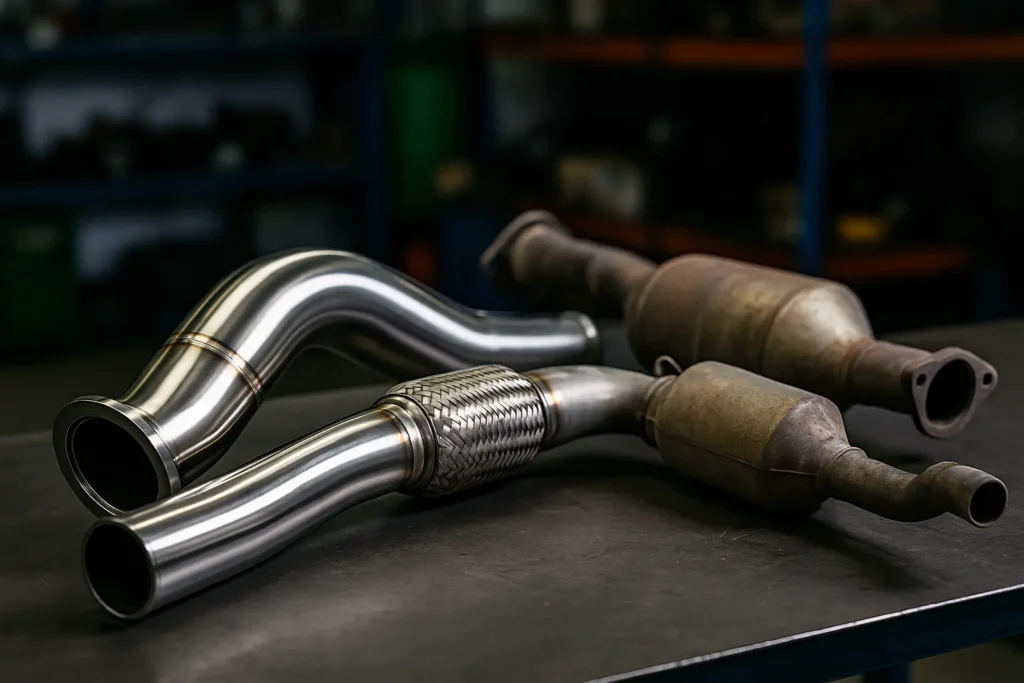
Performance Gains: Downpipe vs Catalytic Converter
Upgrading a Downpipe
Downpipe upgrades usually deliver the largest performance gains, especially on turbocharged engines.
Benefits include:
- Faster turbo spool
- Increased horsepower and torque (often 10–40 HP)
- Improved throttle response
⚠ Most downpipe upgrades require engine tuning, especially catless setups.
Upgrading a Catalytic Converter
Replacing a restrictive stock catalytic converter with a high-flow catalytic converter offers more modest gains.
Expected results:
- Small horsepower increase (3–10 HP)
- Slightly better throttle response
- Cleaner emissions compared to catless setups
For daily drivers, this is often the safer option.
When Is It Better to Upgrade the Catalytic Converter Instead?
Upgrading only the catalytic converter is usually the better choice when:
- You need to pass emissions tests
- You want quieter, cleaner daily driving
- Your stock catalytic converter is failing (P0420 code)
- You live in a region with strict emissions laws
- You don’t want to retune your engine
In many cases, a high-flow catalytic converter delivers enough improvement without legal or tuning risks.
How Do Downpipes Affect Backpressure Compared to Catalytic Converters?
Downpipes
High-flow or catless downpipes significantly reduce backpressure by:
- Using larger pipe diameters
- Smoother bends
- Fewer internal restrictions
This allows exhaust gases to exit faster, improving turbo efficiency and power.
Catalytic Converters
Stock catalytic converters prioritize emissions reduction, which increases restriction. Even high-flow catalytic converters still create more backpressure than catless downpipes—but far less than OEM units.
Legal and Tuning Considerations
- Catless downpipes: Almost always illegal for street use
- Catted downpipes: Often legal only if emissions-certified
- Catalytic converter upgrades: Usually safest for inspections
- Tuning: Downpipes often require ECU tuning; catalytic converters usually do not
Always check local laws before modifying your exhaust. For a system-level explanation of where converters and pipes sit in your car, read our guide on catalytic converter vs exhaust.
How Do Downpipes Affect Backpressure Compared to Catalytic Converters?
Downpipes
High-flow or catless downpipes significantly reduce backpressure by:
- Using larger pipe diameters
- Smoother bends
- Fewer internal restrictions
This allows exhaust gases to exit faster, improving turbo efficiency and power.
Catalytic Converters
Stock catalytic converters prioritize emissions reduction, which increases restriction. Even high-flow catalytic converters still create more backpressure than catless downpipes—but far less than OEM units.
Legal and Tuning Considerations (Very Important)
- Catless downpipes: Almost always illegal for street use
- Catted downpipes: Often legal only if emissions-certified
- Catalytic converter upgrades: Usually safest for inspections
- Tuning: Downpipes often require ECU tuning; catalytic converters usually do not
Conclusion
When comparing catalytic converter vs downpipe, the right choice depends on your priorities.
- Choose a catalytic converter upgrade if legality, emissions compliance, and daily drivability matter most.
- Choose a high-flow catted downpipe if you want stronger performance without going fully illegal.
- Avoid catless downpipes unless the car is track-only.
For most drivers, a high-flow catted downpipe offers the best balance between power, emissions, and reliability—provided local laws allow it.


