P0420 Code: What Is Causing This Engine Warning?
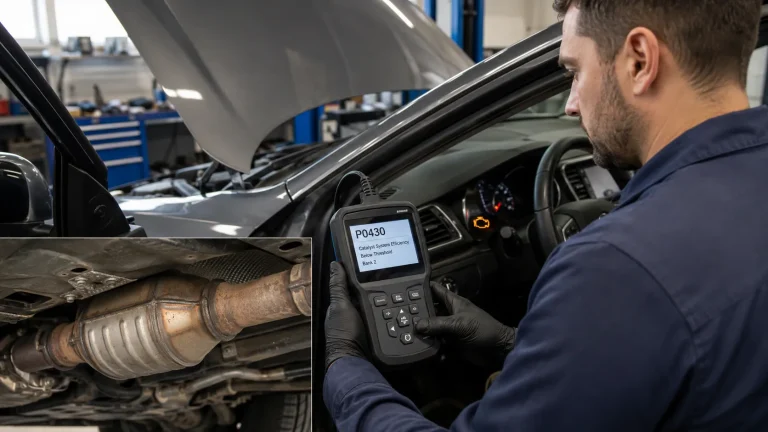
If your check engine light is on and your scanner shows a P0420 code, don’t assume you need a new catalytic converter. P0420 stands for “Catalyst System Efficiency Below Threshold (Bank 1),” meaning your car’s computer has detected that the catalytic converter is not cleaning exhaust gases as efficiently as expected.
However, a P0420 code does not automatically mean the catalytic converter has failed. In many cases, the problem is caused by issues such as a faulty oxygen sensor, an exhaust leak, or engine performance problems. This guide explains the most common causes of a P0420 code, how to diagnose it step by step, and what you can expect to pay for repairs.
What Does the P0420 Code Mean?
P0420 is an emissions monitoring code, not an engine damage code. Your catalytic converter’s job is to take the nasty stuff in your exhaust — carbon monoxide, unburned fuel, nitrogen oxides — and chemically convert it into less harmful gases before it leaves the tailpipe. The P0420 code is your engine computer (the ECM or PCM) reporting that, based on what its sensors are seeing, the converter on Bank 1 isn’t pulling its weight anymore.
Bank 1 is simply the side of the engine that contains cylinder number one. On a four-cylinder car, there’s usually only one bank, so P0420 covers the only converter you have. On a V6 or V8, there are two banks, each with its own converter and its own code — which brings us to the sensors that make this whole system work.
How the Upstream and Downstream O2 Sensors Trigger P0420
Your exhaust system has two oxygen sensors that matter here: one before the catalytic converter (upstream) and one after it (downstream). The upstream sensor watches the raw exhaust coming out of the engine, and on a healthy car its voltage signal bounces around constantly — roughly 0 to 1 volt — as the computer fine-tunes the air-fuel mixture.
The downstream sensor watches what comes out the other side of the converter. If the converter is doing its job, it smooths out those oxygen fluctuations, so the downstream sensor should read calm and steady — typically around 0.7 to 0.9 volts on a warmed-up engine.
Here’s the key: when the downstream sensor starts bouncing around just like the upstream one, the computer concludes the converter isn’t changing the exhaust anymore. The two signals “mirror” each other, the efficiency calculation falls below the manufacturer’s threshold, and P0420 gets stored. Remember that mirroring concept — it’s the heart of diagnosing this code later.
P0420 vs P0430: What’s the Difference?
They’re the same fault on opposite sides of the engine. P0420 is Bank 1; P0430 is Bank 2. If you drive a four-cylinder, you’ll likely only ever see P0420. If you have a V6 or V8 and both codes appear together, that’s actually a useful clue — it’s unlikely both converters died at the same moment, so look for a shared cause like an engine running rich, burning oil, or a sensor problem.
Is It Safe to Drive With a P0420 Code?
In most cases, yes — for a while. P0420 on its own rarely makes a car undriveable, and many people drive with it for months without noticing anything beyond the check engine light. But “safe to drive” comes with three caveats.
First, you will fail an emissions inspection with this code stored, so don’t put it off if your test date is approaching. Second, if the converter is genuinely failing because of an engine problem — misfires, burning oil, a rich mixture — that root problem keeps doing damage the whole time you wait. Third, in the worst case, a badly deteriorated converter can break apart internally and clog the exhaust, which causes real drivability problems like power loss and stalling. That’s uncommon, but it’s the scenario you’re trying to avoid by dealing with the code sooner rather than later.
One hard rule: if your check engine light is flashing rather than steady, that indicates active misfires that can destroy a converter quickly. Stop driving and get it looked at.
P0420 Code but the Car Runs Fine — Now What?
This is the most common version of the story, and it confuses people: the light is on, the scanner says P0420, and the car drives exactly like it always has. That’s normal. Catalyst efficiency is an emissions measurement, not a performance measurement, and a converter can drift below the threshold long before you’d ever feel it from the driver’s seat.
A car that runs fine with a P0420 is actually mildly good news — it makes a hidden engine problem less likely and a tired converter or lazy sensor more likely. It doesn’t mean you can ignore the code forever (the emissions test will see it even if you can’t feel it), but it does mean you have time to diagnose it properly instead of panic-buying parts.
Common Causes of P0420 (Cheapest to Most Expensive)
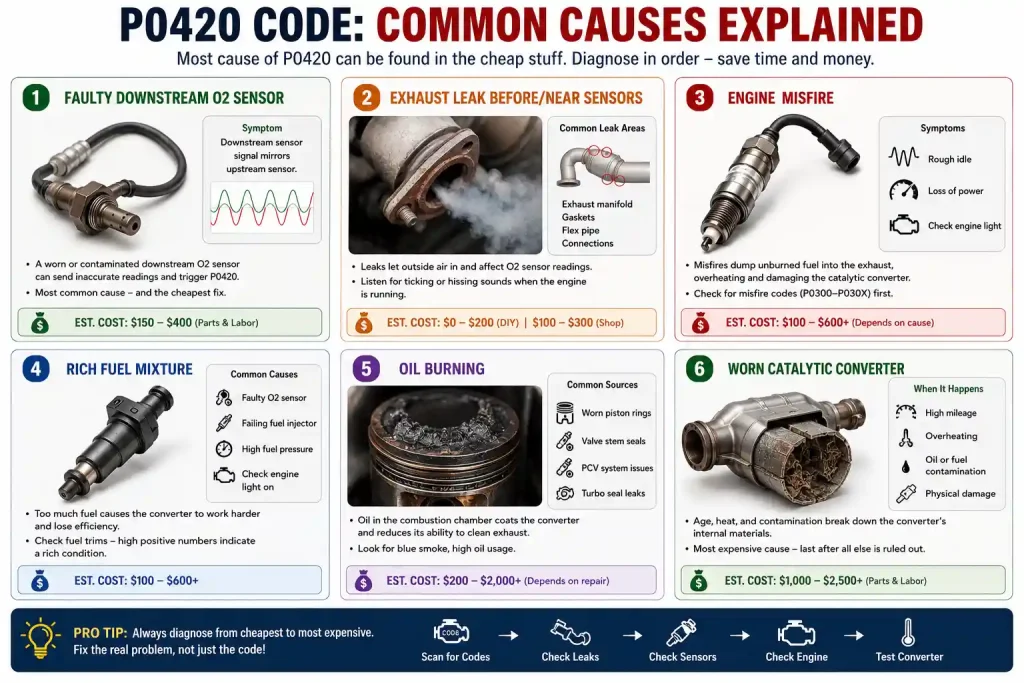
Most articles list causes in random order. We’re listing them in the order your wallet cares about — because the smart way to attack a P0420 is to rule out the cheap stuff before touching the expensive stuff.
1. A Faulty Downstream O2 Sensor (the Hopeful Fix)
The entire P0420 decision rests on what the downstream oxygen sensor reports. If that sensor is worn, contaminated, or has damaged wiring, it can send sloppy readings that make a perfectly good converter look bad. Sensors are wear items — they slow down with age — and replacing one runs roughly $150–$400 installed, often less if you do it yourself. This is the cause everyone hopes for, and it’s worth ruling out before anything else.
2. An Exhaust Leak Before or Near the Sensors
A crack in the exhaust manifold, a failed gasket, or a rusted-through flex pipe lets outside air get pulled into the exhaust stream. That extra oxygen scrambles the sensor readings and can trigger P0420 even when the converter is fine. Listen for ticking or blowing sounds near the engine, especially on cold startup. Repairs typically run $100–$300.
3. Engine Problems That Poison the Converter
This is the category people skip, and it’s why so many replacement converters die young. Misfires send raw unburned fuel into the exhaust, where it burns inside the converter and overheats it. A rich or lean air-fuel mixture — from a leaky injector, a bad MAF sensor, wrong fuel pressure, or a vacuum leak — slowly degrades the catalyst. Burning oil or leaking coolant coats the catalyst material and smothers it. If your car has any of these problems, they are not just triggering the code — they are actively causing the converter damage. Fix these first, always.
4. A Genuinely Worn-Out Catalytic Converter
Converters don’t last forever. The precious-metal coating inside degrades with age and mileage, and somewhere past the 100,000-mile mark, efficiency can simply fall below the threshold through honest wear. If the diagnosis below points here and there’s no underlying engine issue, replacement is the fix — and it’s the expensive one, which is exactly why it sits at the bottom of this list.
5. A Cheap Aftermarket Converter That Never Measured Up
A special case worth knowing: if your P0420 appeared after a converter was already replaced, the prime suspect is the replacement itself. Budget aftermarket converters often contain less catalyst material than OEM units and can fail the efficiency monitor from day one — or after a short honeymoon period. Incorrect installation position matters too: a converter mounted too far downstream never reaches proper operating temperature. If this is your situation, the fix is an OEM or CARB-compliant unit, not another bargain part.
How to Diagnose a P0420 Code (Follow the Decision Tree)
[IMAGE: decision-tree flowchart graphic — see design spec. Alt: “P0420 diagnostic flowchart: how to diagnose catalyst efficiency code step by step”. Add a “save or pin this chart” prompt beneath it.]
The golden rule of P0420: never replace a part to find out if it was the problem. Work through this sequence in order — it’s arranged so the cheap possibilities eliminate themselves before you spend real money.
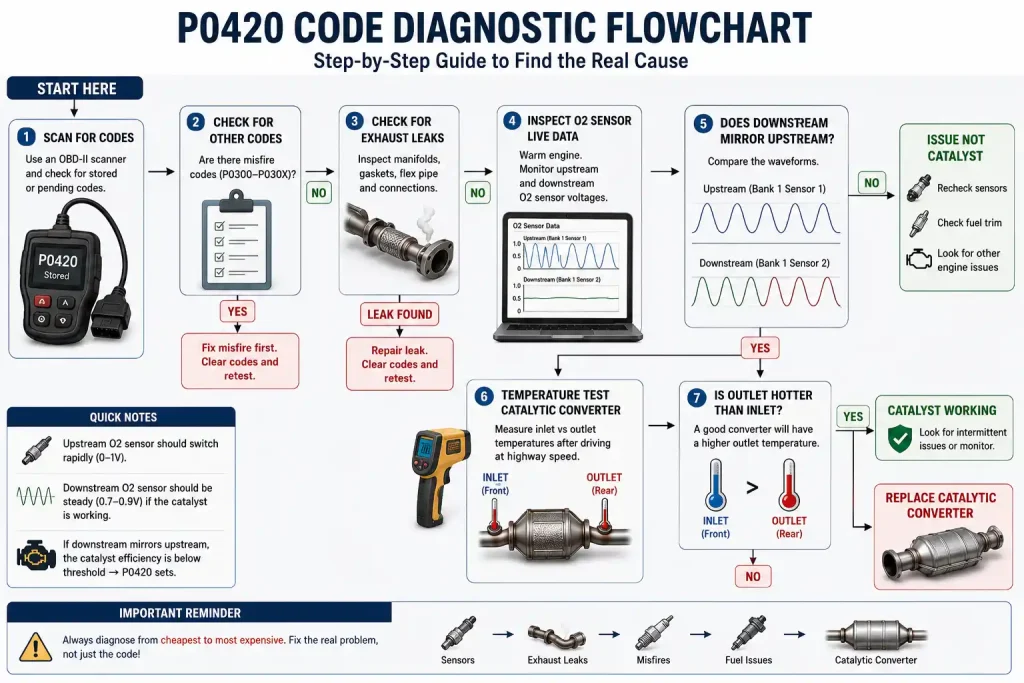
Step 1: Scan for Other Codes First
Plug in your OBD-II scanner and read everything, not just P0420. If you see misfire codes (P0300 through P0308), stop — fix the ignition or fuel problem first, because misfires both trigger this code and destroy converters. If you see mixture codes (P0171 or P0174 for lean, P0172 or P0175 for rich), same deal: solve the mixture problem, clear the codes, drive a few days, and see if P0420 comes back. A surprising number of P0420s disappear at this step without touching the exhaust system at all.
Step 2: Inspect for Exhaust Leaks
With the engine cold, start it and listen around the exhaust manifold and the pipes ahead of the downstream sensor. Ticking, puffing, or blowing sounds — or visible soot streaks at joints — point to a leak. Repair it, clear the code, and retest before going any further.
Step 3: Read the O2 Sensors’ Live Data
This is the step that separates guessing from knowing, and any scanner with live-data mode (even a $30 Bluetooth dongle and a phone app) can do it. With the engine fully warmed up, watch both sensors. Healthy: the upstream sensor fluctuates rapidly between about 0 and 1 volt, while the downstream sensor holds relatively steady around 0.7–0.9 volts. Failing catalyst: the downstream signal bounces up and down in rhythm with the upstream one — the mirroring we talked about earlier.
Here’s the counterintuitive part: if the downstream sensor looks steady and healthy but the code keeps returning, suspect the sensor or its wiring before the converter. A working catalyst smooths out the oxygen fluctuations — so a downstream sensor that still sees them is watching a converter that isn’t doing its job, but a downstream sensor reporting calm, normal readings alongside a stored P0420 may itself be the component telling lies.
Step 4: Temperature-Test the Converter
A cheap infrared thermometer settles a lot of arguments. With the engine hot after a 15-minute drive, measure the exhaust temperature at the converter’s inlet and outlet. A working converter generates heat from the chemical reactions inside it, so the outlet should read noticeably hotter than the inlet. Near-identical temperatures, combined with mirrored sensor data from Step 3, are strong confirmation the catalyst is no longer working.
Step 5: Verify the Converter Itself
Before ordering parts, confirm what’s currently on the car. Is it the original OEM converter, or has someone replaced it with an aftermarket unit? Is it mounted in the factory position? If you’ve reached this step with mirrored sensor data, similar inlet/outlet temperatures, no other codes, and no leaks, you’ve done a proper diagnosis — and replacement is the legitimate conclusion, not a guess.
How to Fix a P0420 Code (and What It Costs)
What you’ll pay depends entirely on which branch of the diagnosis you landed on. Here are realistic parts-plus-labor ranges:
| Fix | Economy car | Truck / SUV | Hybrid | Luxury / performance |
|---|---|---|---|---|
| Downstream O2 sensor | $150–$300 | $200–$400 | $200–$450 | $300–$600 |
| Exhaust leak repair | $100–$250 | $150–$350 | $150–$350 | $250–$500 |
| Misfire/mixture repair (varies widely) | $150–$600 | $200–$800 | $200–$800 | $400–$1,200+ |
| Catalytic converter replacement | $900–$1,800 | $1,200–$2,500 | $1,500–$4,000 | $3,000–$7,000+ |
Will a Catalytic Converter Cleaner Clear a P0420?
Sometimes — with honest limits. If your converter is only marginally contaminated (light carbon or oil fouling) and the root cause has been fixed, a fuel-additive cleaner can occasionally nudge efficiency back above the threshold, at least for a while. It will not resurrect a converter whose catalyst material is worn out, and it does nothing for a bad sensor or an exhaust leak. If your converter is borderline, a cleaner is a cheap first attempt — here are the ones actually worth trying.
Why You Must Fix the Root Cause Before Replacing the Converter
This is the single most expensive mistake in the P0420 universe. If misfires, oil burning, or a bad mixture killed your old converter, they will kill the new one too — sometimes within months. Shops see this constantly: a customer pays for a converter twice because nobody asked why the first one failed. Whatever you found in Steps 1–3 of the diagnosis gets fixed before the new converter goes in. No exceptions.
Should You Just Reset the Code?
You can clear P0420 with any scanner, and the light will go off — temporarily. If the underlying condition still exists, the code returns after a few drive cycles. And no, clearing it right before an emissions test doesn’t work: the test checks your car’s “readiness monitors,” which reset along with the codes, and an unready system is an automatic fail in most places. The only legitimate use for clearing the code is verification — clear it after a repair, drive normally for a few days, and confirm it stays gone.
Can a P0420 Code Fix Itself?
Occasionally, yes. Catalyst efficiency hovers near the threshold on older converters, and a borderline reading can trip the code on one drive cycle and pass on the next — especially if conditions change, like a long highway run that gets the converter fully up to temperature. If the code clears itself and stays gone, it may have been a one-off. If it keeps returning, even intermittently, something real is going on, and the decision tree above is your next stop. An intermittent P0420 is a converter sending you a polite early warning; the same code returning instantly after every clear is a converter that’s done.
P0420 Causes by Car Brand
Patterns differ by manufacturer. These are starting points, not verdicts — always confirm with the diagnosis above.
Toyota and Nissan
Most often a genuinely worn converter, with oil consumption as the frequent root cause. Check for blue exhaust smoke before condemning the converter alone.
Honda and Subaru
Converter wear is common, particularly on Subaru’s boxer engines. Rule out exhaust leaks and vacuum leaks first; Honda’s converters are also high-value theft targets, so confirm yours is the original part.
Chevrolet and GM
Exhaust manifold leaks are a classic GM trigger — listen for ticking at cold start before assuming the converter or sensor is bad.
Ford
Vacuum leaks and EGR-related faults that skew the air-fuel mixture show up frequently. Scan carefully for mixture codes before touching exhaust parts.
Volkswagen, Audi, and VAG Cousins
Check the PCV/check-valve system and crankcase ventilation for sludge — clogged ventilation makes these engines burn oil, which fouls the converter. Also inspect the exhaust flex pipes for leaks.
Related Trouble Codes
- P0430 — the identical fault on Bank 2; both together point to a shared engine-side cause. [INTERNAL LINK]
- P0300–P0308 — misfires; the number one converter killer. Fix before anything else.
- P0171 / P0174 — lean mixture; P0172 / P0175 — rich mixture. Both degrade catalysts over time.
- P0135 / P0141 — O2 sensor heater circuit faults; a sensor that heats slowly reports bad data and can confuse the catalyst monitor.
Frequently Asked Questions
What is the most common cause of a P0420 code?
A worn catalytic converter is the most common confirmed cause, but a failing downstream O2 sensor is the most common cheap cause — which is why you always rule the sensor out first.
Can I drive with a P0420 code?
Usually yes, short-term, if the car runs normally and the light is steady. You’ll fail emissions testing with the code stored, and any underlying engine problem keeps causing damage while you wait.
How much does it cost to fix a P0420 code?
Anywhere from about $150 (a downstream O2 sensor) to $2,500 or more (converter replacement on some vehicles). The diagnosis determines the bill — which is why diagnosing before replacing matters so much.
Will a P0420 code clear itself?
A borderline converter can pass on some drive cycles and fail on others, so the code may come and go. A code that keeps returning means a real underlying issue.
Can a catalytic converter cleaner fix P0420?
Occasionally, if the converter is only marginally contaminated and the root cause is fixed. It won’t restore a worn-out catalyst or fix a bad sensor.
What’s the difference between P0420 and P0430?
The same fault on different sides of the engine: P0420 is Bank 1 (the side with cylinder 1), P0430 is Bank 2 on V-type engines with two converters.
Why do I still have a P0420 after replacing the catalytic converter?
Usually one of three things: a cheap non-CARB aftermarket converter that can’t meet the efficiency threshold, an unfixed root cause (misfires, oil burning, mixture problems) damaging the new unit, or an O2 sensor or wiring fault that was the real problem all along.
The Bottom Line
A P0420 code is a question, not a verdict. It tells you the catalyst monitor isn’t happy — it doesn’t tell you why. Work the causes from cheapest to most expensive: other codes first, then leaks, then sensor data, then the temperature test, and only then the converter itself. Do that, and you’ll either solve this for a fraction of what you feared, or replace the converter once, correctly, with confidence it won’t happen again.