P0430 Code: What Your Scanner Isn’t Telling You
If your check engine light is on and your scanner shows P0430, don’t assume you need a new catalytic converter. Many drivers see this code and immediately start pricing expensive converter replacements, only to discover later that the real problem was an oxygen sensor, exhaust leak, or engine issue.
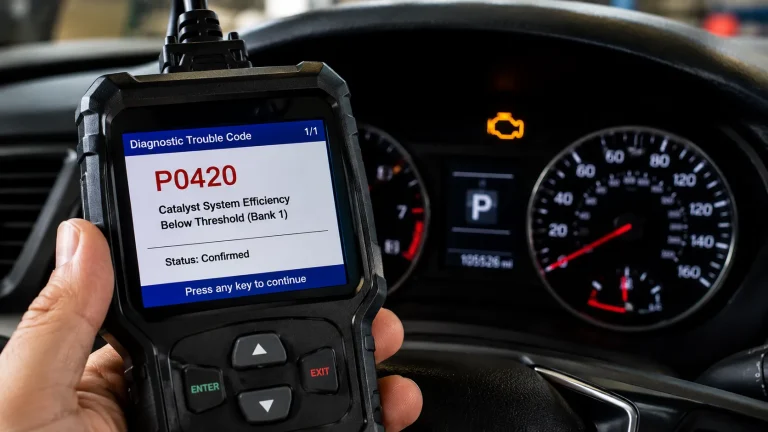
P0430 means “Catalyst System Efficiency Below Threshold (Bank 2).” The engine computer has detected that the catalytic converter on Bank 2 is not cleaning exhaust gases as efficiently as expected. While a failing converter can cause this code, it is far from the only possibility. Proper diagnosis can save hundreds or even thousands of dollars in unnecessary repairs.
What Does P0430 Mean?
P0430 indicates that the catalytic converter on Bank 2 is operating below the efficiency threshold programmed into the vehicle’s engine control module (ECM).
Is It Serious?
The code is moderately serious. The vehicle will usually continue to run, but ignoring the issue can lead to increased emissions and potentially more expensive repairs later.
Can You Drive With It?
In most cases, yes. However, you should diagnose and repair the problem as soon as possible to prevent further damage.
Typical Repair Cost
Repairs can range from less than $100 for a minor exhaust leak to more than $3,500 for catalytic converter replacement.
Catalytic Converter Overview
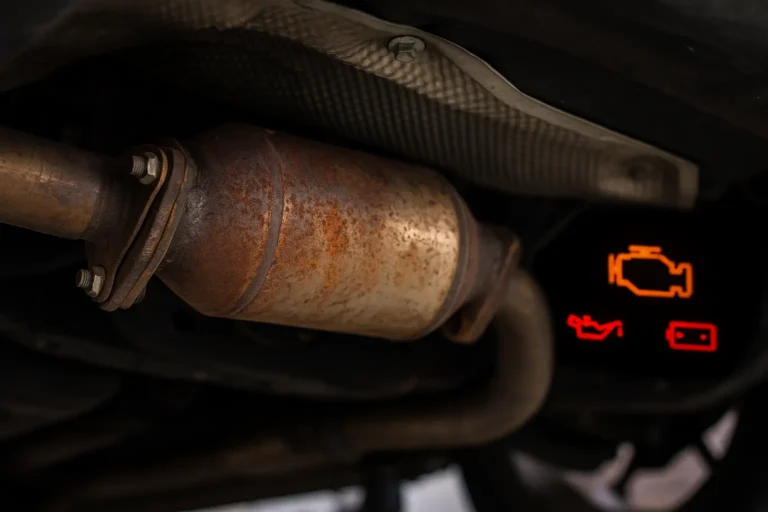
A catalytic converter is an exhaust system part that reduces harmful emissions before exhaust leaves the tailpipe. The catalytic converter helps convert carbon monoxide, hydrocarbons, and nitrogen oxides into less harmful gases.
The catalytic converter works with the engine control module, oxygen sensors, fuel system, ignition system, and exhaust system. A problem in one part can affect catalytic converter efficiency and set the engine code P0430.
The main components involved in a P0430 diagnosis include:
- Catalytic converter
- Upstream oxygen sensor
- Downstream oxygen sensor
- Exhaust manifold
- Exhaust pipes
- Engine control module
- Fuel injectors
- Spark plugs
- Ignition coils
- Mass airflow sensor
- Vacuum lines
The catalyst light-off strategy matters because the catalytic converter must reach its operating temperature before the catalyst can clean exhaust gases efficiently. A cold start enrichment fault can delay this process and allow rich exhaust gases to reach the converter.
Catalyst efficiency also depends on fuel control. Fuel trim values show how much the engine control module adds or removes fuel. A fuel trim limit exceeded condition means the engine is correcting too much fuel or air. A rich exhaust spike detection issue can overheat the catalyst. A lean condition can raise oxygen levels and confuse oxygen sensor readings.
A failed catalytic converter can develop internal damage, clogging, contamination, or subthreshold voltage degradation in the sensor pattern. A restricted converter can also affect exhaust backpressure sensor data and reduce engine performance.
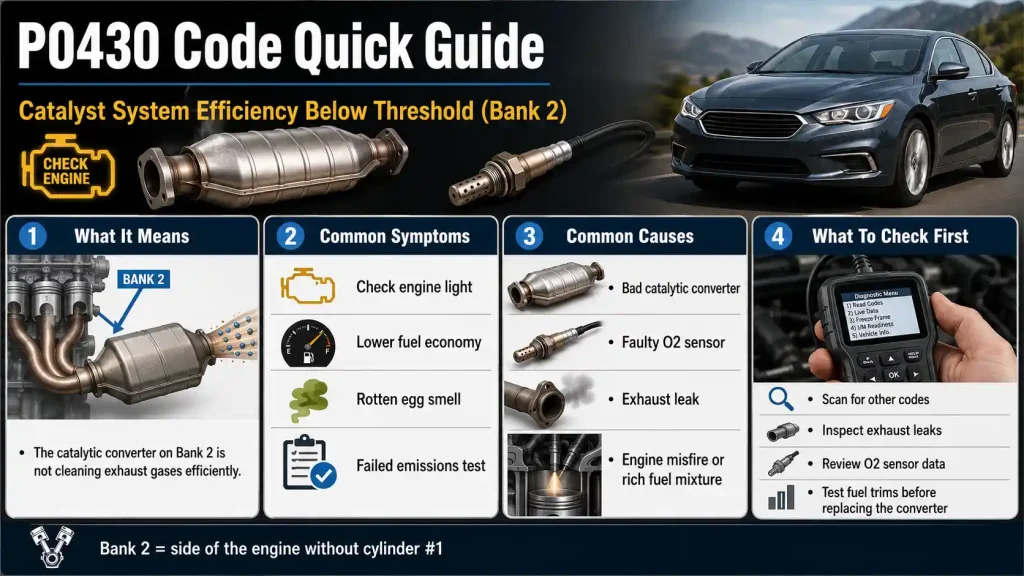
What Is Bank 2?
Bank 2 refers to the side of the engine that does not contain cylinder number one.
You will only see Bank 2 on engines that have two cylinder banks, such as:
- V6 engines
- V8 engines
- Flat-four engines (Subaru)
- Flat-six engines
Most inline four-cylinder engines have only one bank and typically trigger P0420 instead of P0430.
What Are the Common Symptoms of a P0430 DTC Code?
The most common symptom of a P0430 DTC Code is an illuminated check engine light. Many vehicles with a P0430 code still drive normally, especially during the early stage of the problem.
There are 7 common symptoms of a P0430 DTC Code:
- Check engine light
- Failed emissions test
- Lower fuel economy
- Sulfur or rotten egg smell
- Reduced engine performance
- Rough idle or misfire symptoms
- No obvious driving symptoms
Check Engine Light
The check engine light turns on when the engine control module stores the P0430 code. The light may stay solid if the vehicle has no severe misfire or major drivability issue.
A flashing check engine light means active misfire damage is possible. Stop hard driving and diagnose the misfire first, if the check engine light flashes.
Failed Emissions Test
A vehicle with an active P0430 code often fails emissions inspection. The fault code means the catalyst monitoring system has detected a problem in the bank 2 catalyst system. The vehicle may also fail if the readiness monitor has not completed a drive cycle after the code was cleared.
Lower Fuel Economy
P0430 can appear with rich condition or lean condition problems. Poor fuel control can increase fuel use and reduce catalytic converter efficiency.
Fuel trim values help identify this issue. High positive trim can point to a vacuum leak or exhaust leak. High negative trim can point to a rich condition, leaking injector, or incorrect sensor signal.
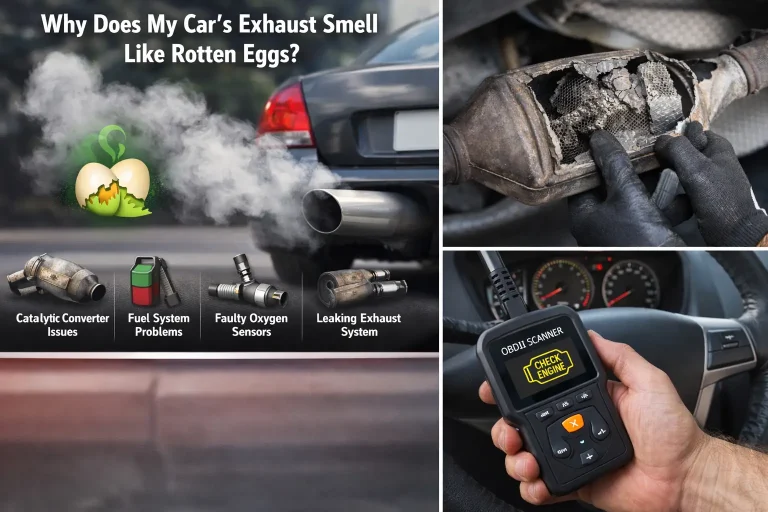
Sulfur or Rotten Egg Smell
A sulfur smell can come from poor converter operation, rich exhaust gases, or fuel quality issues. The smell does not confirm a failed catalytic converter by itself.
Reduced Engine Performance
A clogged catalytic converter can reduce exhaust flow. The driver may feel slow acceleration, weak power, or poor throttle .Exhaust backpressure sensor data and backpressure testing can confirm a restriction.
Rough Idle or Misfire Symptoms
P0430 can appear after engine misfire detection. Misfires send unburned fuel into the catalytic converter and can overheat the catalyst material.
Spark plugs, ignition coils, fuel injectors, and compression should be checked when misfire codes appear with P0430.
No Obvious Driving Symptoms
A P0430 code can appear when the vehicle runs fine. This happens because the code focuses on exhaust emission control and catalytic converter efficiency, not always on engine power. A vehicle can drive normally while the downstream oxygen sensor detects poor catalyst efficiency.
What Causes a P0430 Code?
The P0430 code is caused by poor Bank 2 catalyst efficiency, false oxygen sensor readings, exhaust leaks, fuel control problems, misfires, or converter damage. The catalytic converter is one possible cause, but the catalytic converter should not be replaced before diagnosis.
There are 10 common causes of a P0430 code:
- Faulty catalytic converter
- Exhaust leak before or near the converter
- Faulty downstream oxygen sensor
- Faulty upstream oxygen sensor
- Rich fuel mixture
- Lean fuel mixture
- Engine misfires
- Dirty or faulty mass airflow sensor
- Vacuum leak
- Oil or coolant contamination
Faulty Catalytic Converter
A faulty catalytic converter cannot store and process oxygen correctly. The downstream oxygen sensor signal starts to follow the upstream oxygen sensor signal. This pattern triggers the catalyst system efficiency below threshold bank 2 code.
Catalytic converter replacement may be needed if testing confirms poor converter efficiency.
Exhaust Leak Before or Near the Converter
An exhaust leak can pull outside air into the exhaust stream. The oxygen sensor sees extra oxygen and sends misleading data to the engine control module.
This exhaust leak mimicking code problem is common near manifold gaskets, flange connections, flex pipes, and cracked exhaust parts.
Faulty Downstream Oxygen Sensor
The downstream oxygen sensor monitors converter performance. A slow sensor, biased sensor, damaged wire, oxygen sensor reference voltage issue, or downstream heater circuit failure can trigger P0430.
Oxygen sensor response time testing helps separate sensor failure from converter failure.
Faulty Upstream Oxygen Sensor
The upstream oxygen sensor controls fuel mixture feedback. A faulty upstream oxygen sensor can cause a rich condition or lean condition, which can damage the catalytic converter and trigger a P0430 code.
Rich Fuel Mixture
A rich fuel mixture sends excess fuel into the exhaust. Rich exhaust spike detection can show repeated high-fuel events that overheat the converter.
Common causes include leaking injectors, high fuel pressure, bad oxygen sensor data, and MAF sensor errors.
Lean Fuel Mixture
A lean fuel mixture adds excess oxygen to the exhaust. Lean conditions can come from vacuum leaks, intake leaks, low fuel pressure, or unmetered air.
Fuel trim values above normal range help identify this cause.
Engine Misfires
Misfires are dangerous for catalytic converters. Unburned fuel enters the converter and creates extreme heat.
Common misfire causes include worn spark plugs, bad coils, injector problems, and engine mechanical faults.
Dirty or Faulty Mass Airflow Sensor
A dirty mass airflow sensor can report incorrect air volume. The engine control module then uses the wrong fuel amount.
A fuel system adaptive reset may be needed after sensor cleaning or fuel control repairs, depending on the vehicle.
Vacuum Leak
A vacuum leak lets unmetered air enter the engine. The engine control module adds fuel to correct the lean condition, and the correction can affect catalytic converter efficiency.
Oil or Coolant Contamination
Burning oil or coolant can coat the catalyst material. Contaminated catalyst material loses efficiency and may trigger P0430.
A blue exhaust smoke pattern can point to oil burning. White smoke, coolant loss, or overheating can point to coolant contamination.
How to Fix a P0430 Code
To fix a P0430 code, scan all codes, inspect the exhaust system, check oxygen sensor readings, review fuel trim values, test for misfires, and replace the catalytic converter only after other causes are ruled out.
Use this 8-step P0430 diagnosis process:
- Scan for all diagnostic trouble codes
- Check freeze frame data
- Inspect for exhaust leaks
- Review oxygen sensor readings
- Check fuel trim values
- Test for misfires
- Test catalytic converter efficiency
- Repair the confirmed cause
Step 1: Scan for All Diagnostic Trouble Codes
A diagnostic scan should come first. P0430 can appear with oxygen sensor codes, fuel trim codes, misfire codes, or air injection system codes.
Common related codes include:
- P0420 catalyst system efficiency below threshold bank 1
- P0130 oxygen sensor circuit fault
- P0136 oxygen sensor circuit fault
- P0171 system too lean
- P0172 system too rich
- P0300 random misfire
- P0301-P0308 cylinder misfire codes
Fix misfire and fuel trim codes first. These codes can cause the P0430 fault code.
Step 2: Check Freeze Frame Data
Freeze frame data shows conditions when the engine code P0430 appeared. Review engine speed, vehicle speed, coolant temperature, fuel trim values, and engine load.
A cold start enrichment fault can show up shortly after startup. A deceleration fuel cut impact can affect catalyst monitoring during coast-down conditions.
Step 3: Inspect for Exhaust Leaks
Inspect the exhaust system before replacing sensors or the catalytic converter.
Check these areas:
- Exhaust manifold
- Manifold gasket
- Flange gasket
- Flex pipe
- Pipe welds
- Converter inlet
- Converter outlet
Black soot marks, ticking noise during cold start, and exhaust smell near the engine can point to leaks.
Step 4: Review Oxygen Sensor Readings
Oxygen sensor readings are central to P0430 diagnosis. Use a scan tool that displays live data.
A normal upstream oxygen sensor switches quickly. A normal downstream oxygen sensor remains steadier after the converter warms up.
| Sensor Pattern | Likely Meaning |
|---|---|
| Upstream switches and downstream stays steady | Converter is likely working |
| Upstream switches and downstream mirrors upstream | Converter efficiency may be low |
| Downstream stays fixed high or low | Sensor or circuit fault may exist |
| Both sensors behave abnormally | Fuel control, wiring, or exhaust leak may exist |
Oscilloscope waveform diagnosis gives a clearer view than basic scan data. A scope can show rear O2 sensor inversion, delayed oxygen sensor response time, and voltage cycling pattern analysis problems.
Step 5: Check Fuel Trim Values
Fuel trim values show how the engine control module is correcting fuel delivery.
| Fuel Trim Reading | Likely Meaning |
| -10% to +10% | Usually normal |
| Above +15% | Lean condition, vacuum leak, exhaust leak, low fuel pressure |
| Below -15% | Rich condition, leaking injector, high fuel pressure, sensor error |
Fuel trim limit exceeded data means the engine control module has reached a correction limit. This condition should be repaired before converter replacement.
Step 6: Test for Misfires
Check spark plugs, ignition coils, injector operation, and compression if misfire codes appear.
Do not ignore a flashing check engine light. Active misfires can damage the catalytic converter quickly.
Step 7: Test Catalytic Converter Efficiency
A shop can test catalytic converter efficiency with temperature testing, backpressure testing, exhaust gas analysis, and scan tool catalyst monitoring.
Catalyst temperature monitoring error data can show whether the converter reaches proper working temperature.
Step 8: Repair the Confirmed Cause
Repair the confirmed cause after testing. Common repairs include:
- Repair exhaust leaks
- Replace faulty oxygen sensors
- Clean or replace the mass airflow sensor
- Fix vacuum leaks
- Replace spark plugs or ignition coils
- Repair fuel injectors
- Replace the catalytic converter
Can I Drive With a P0430 Code?
Yes, you can usually drive with a P0430 code for a short time, but you should diagnose the cause soon. Long-term driving can increase emissions, reduce fuel economy, damage the catalytic converter, and cause emissions test failure.
Do not keep driving normally if the check engine light flashes, the engine misfires, the vehicle loses power, or the exhaust smells strongly of sulfur.
How Do I Fix Code P0430?
You fix code P0430 by repairing the cause of low catalyst efficiency, not by clearing the code. Clearing the code only resets the warning. The P0430 code returns when the engine control module runs the catalyst monitor again and sees the same fault.
What Is P0430 00 Code?
P0430 00 code usually means the same fault: Catalyst System Efficiency Below Threshold on Bank 2. The “00” is often a manufacturer or scan-tool suffix that shows the base fault without a more specific sub-condition.
Searches such as engine code P0430 00, p0430 00 code Ford, Chevy code P0430 00, GM code P0430 00, and Ford code P0430 00 EC usually point to the same bank 2 catalyst efficiency issue.
P0430 Code on Common Vehicles
P0430 can appear on many vehicles. The diagnosis process stays similar, but common causes can vary by engine design and exhaust layout.
| Vehicle Search | Common Diagnostic Focus |
| Buick Enclave code P0430 00 | Bank 2 converter, oxygen sensors, exhaust leak |
| Chevy code P0430 00 | Converter efficiency, fuel trims, misfires |
| GMC Yukon XL code P0430 | Bank 2 catalyst, exhaust leaks, O2 data |
| Lexus GS 350 code P0430 | Air-fuel sensor data, converter efficiency |
| Mercury code P0430 | Exhaust leaks, sensors, aged converter |
| 1998 Chevy Silverado P0430 | Exhaust leak, O2 sensor, converter age |
| 2012 Jeep Grand Cherokee P0430 | Bank 2 catalyst, misfire history |
| 2013 Ford Explorer P0430 | Exhaust leak, O2 sensor response time |
| 2014 Chevy Silverado 5.3 P0430 | Fuel trim values, exhaust leaks, converter efficiency |
| 2015 Yukon P0430 | Bank 2 converter and sensor readings |
| 2016 F-150 5.0 P0430 | Exhaust leak, catalyst monitor data |
| 2016 Honda Pilot P0430 | Bank 2 catalyst, oxygen sensor readings |
| 2018 F-150 5.0 P0430 | O2 data, fuel trims, converter efficiency |
The Original Stiction Eliminator
The Original Stiction Eliminator is an engine oil additive designed to help clean internal oil-side deposits in diesel engines. Stiction refers to sticky friction that can affect oil-wetted components and engine operation.
The Original Stiction Eliminator is not a direct catalytic converter replacement and does not directly repair a broken Bank 2 catalytic converter. The product can support engine cleanliness when oil-side deposits affect engine performance.
A clean-running engine helps reduce conditions that can harm the catalytic converter. Poor combustion, oil contamination, and fuel control problems can contribute to catalytic converter efficiency issues. Fix the mechanical cause first, then use additives only as supporting maintenance.
Use The Original Stiction Eliminator when the product matches the engine type, oil system needs, and manufacturer guidance. Do not use any additive as a substitute for oxygen sensor testing, exhaust leak repair, fuel trim diagnosis, or catalytic converter testing.
Diesel Extreme
Diesel Extreme is a diesel fuel additive designed to support fuel system cleanliness and diesel combustion quality. A cleaner diesel fuel system can help reduce poor combustion patterns that contribute to exhaust system problems.
Diesel Extreme does not erase a P0430 code by itself. P0430 is an OBD-II trouble code tied to catalyst efficiency on Bank 2. The code still requires proper diagnosis with a scan tool, oxygen sensor readings, fuel trim values, and exhaust inspection.
Diesel fuel system maintenance can matter when poor fuel quality, injector deposits, or rich exhaust spike detection affects exhaust emission control. A poorly running engine can increase emissions and stress the catalytic converter.
Use Diesel Extreme as part of maintenance, if the additive suits the engine and fuel system. Repair confirmed faults first when the vehicle has a check engine light, misfire code, fuel trim code, oxygen sensor code, or exhaust leak.
Everyday Diesel Treatment
Everyday Diesel Treatment is a diesel fuel additive designed for regular fuel system maintenance. The product supports daily diesel fuel treatment needs, depending on vehicle use, fuel quality, and product directions.
Everyday Diesel Treatment does not replace P0430 diagnosis. A P0430 code still means the catalyst system efficiency below threshold bank 2 monitor has detected a problem.
Regular fuel maintenance can support combustion quality. Better combustion helps reduce unburned fuel, soot, and exhaust conditions that can stress emission control parts.
Use Everyday Diesel Treatment as a preventive product when it fits the vehicle. Do not rely on fuel additives to fix a damaged catalytic converter, bad downstream oxygen sensor, exhaust leak, downstream heater circuit failure, or fuel trim limit exceeded condition.
Speak With Our Experts or Try Our Additives
Speak with an expert before replacing the catalytic converter, if the P0430 code appears with unclear symptoms or repeated repairs. Expert diagnosis can save money by separating catalytic converter failure from oxygen sensor faults, exhaust leaks, fuel trim problems, and misfires.
A correct P0430 diagnosis should answer 5 questions:
- Is Bank 2 confirmed?
- Are other diagnostic trouble codes present?
- Are oxygen sensor readings normal?
- Are fuel trim values within range?
- Has the exhaust system been inspected for leaks?
Try additives only when the product fits the engine and the problem is related to maintenance, fuel quality, or oil-side deposits. Additives such as Stiction Eliminator, Diesel Extreme, and Everyday Diesel Treatment can support maintenance, but additives do not replace scanner diagnosis or failed part repair.
The best repair path is simple:
- Diagnose the P0430 code.
- Repair exhaust leaks, sensor faults, fuel issues, or misfires.
- Replace the catalytic converter only when testing confirms converter failure.
- Use maintenance products after the main fault has been identified.
A P0430 code helps drivers find emission control problems before larger repairs appear. The code points to Bank 2 catalytic converter efficiency, but the real cause can involve the catalytic converter, oxygen sensor readings, fuel trim values, engine misfire detection, or exhaust leak symptoms. Proper testing protects the exhaust system, reduces repair cost, and helps prevent the P0430 DTC Code from returning.
Frequently Asked Questions
Does P0430 Always Mean a Bad Catalytic Converter?
No. Exhaust leaks, oxygen sensors, misfires, and fuel trim problems can all trigger the code.
Can an Oxygen Sensor Cause P0430?
Yes. A faulty oxygen sensor can provide inaccurate readings that make the ECM believe the converter is inefficient.
How Much Does It Cost to Fix P0430?
Repairs can range from under $100 for minor issues to more than $3,500 for converter replacement.
Will P0430 Clear Itself?
Usually not. The underlying problem must be corrected before the code will remain cleared.
Can Bad Spark Plugs Cause P0430?
Yes. Misfires caused by worn spark plugs can damage the catalytic converter and trigger efficiency codes.
Is P0430 Covered Under Emissions Warranty?
Some vehicles may qualify for emissions warranty coverage depending on age, mileage, and local regulations.
Conclusion
A P0430 code indicates that the catalytic converter on Bank 2 is not meeting the efficiency standards expected by the engine computer. While a failed converter is one possible cause, it should never be your first assumption.
Exhaust leaks, oxygen sensor failures, fuel trim problems, vacuum leaks, and engine misfires are all capable of triggering P0430. Diagnosing these issues first can save significant money and prevent unnecessary parts replacement.
Before spending thousands on a catalytic converter, inspect the exhaust system, analyze oxygen sensor data, review fuel trims, and resolve any engine performance problems. A systematic diagnosis is the most effective way to fix P0430 correctly and keep it from returning.