How Many Catalytic Converters Does a Car Have?
If your repair bill just quoted you for two catalytic converters — or you’re watching your neighbor’s Prius get ransacked in a parking lot — you’ve probably asked the same question thousands of drivers search every day: how many catalytic converters does a car actually have?
The answer isn’t one-size-fits-all, and getting it wrong can cost you hundreds of dollars in the wrong parts, a failed emissions test, or a preventable theft.
Here’s exactly what you need to know, broken down by engine type, vehicle category, and model year.
The Short Answer: Most Cars Have 1 to 4 Catalytic Converters
| Vehicle Type | Typical Number of Catalytic Converters |
|---|---|
| Small 4-cylinder car (Honda Civic, Toyota Corolla) | 1 |
| Midsize V6 sedan (Toyota Camry, Honda Accord V6) | 2–3 |
| V8 truck or SUV (Ford F-150 5.0L, Chevy Tahoe) | 2–4 |
| Luxury or performance vehicle (BMW 7 Series, Mustang GT500) | 3–4 |
| Hybrid vehicle (Toyota Prius, Ford Escape Hybrid) | 2–4 |
| Modern diesel vehicle (RAM 1500 EcoDiesel, VW Jetta TDI) | 1–2 + DPF/SCR |
The number depends on three things: engine configuration, exhaust layout, and the emissions standards the vehicle was built to meet. Let’s break each one down.
Why Engine Size Determines Converter Count
4-Cylinder Engines: Almost Always 1 Catalytic Converter
Compact cars with inline four-cylinder engines — think a 2022 Honda Civic or Toyota Corolla — route all exhaust gases through a single pipe. One catalytic converter handles the entire job cleanly and efficiently.
That said, many modern 4-cylinder cars also include a pre-catalytic converter (more on that below), so even “one-cat” vehicles may technically have two units in the system.
V6 and V8 Engines: Typically 2 to 4 Catalytic Converters
Here’s where it gets interesting. V6 and V8 engines have two banks of cylinders firing exhaust on opposite sides of the engine. Because the exhaust gases split into two separate paths, each path needs its own catalytic converter.
A Ford F-150 with a 5.0L V8, for example, runs a true dual exhaust system — meaning at minimum two main catalytic converters, often accompanied by two pre-cats upstream, totaling four units.
This is also why V8 trucks and SUVs are prime targets for catalytic converter theft — they carry more precious metals (platinum, palladium, rhodium) and are easier to access due to higher ground clearance.
If you’re curious about why newer systems are more complex, this also explains why catalytic converters are so expensive today.
What Is a Pre-Catalytic Converter?
A pre-catalytic converter (pre-cat) is a smaller, secondary converter mounted close to the engine — sometimes directly on the exhaust manifold.
Its purpose is timing: a cold engine produces the most pollution in the first 60–90 seconds of operation. The pre-cat heats up within seconds and begins filtering emissions immediately, before the main catalytic converter reaches operating temperature (typically 400–600°C).
Vehicles most likely to have pre-cats:
- Cars built after 1996 (OBD2-compliant vehicles)
- California CARB-compliant models
- Hybrids and modern luxury vehicles
If your mechanic mentions a “upstream cat” or “manifold cat,” they’re referring to the pre-cat — and yes, it’s a separate, billable replacement from the main converter.
How Model Year Affects the Number of Catalytic Converters
Pre-1990s Vehicles
Older cars were built under much looser emissions regulations. Most used a single catalytic converter and a simpler exhaust design. Replacement costs were also significantly lower, since the converters contained less precious metal.
1990–2000s Vehicles
The introduction of OBD2 systems in 1996 changed everything. Oxygen sensors before and after each converter began reporting emissions data to the ECU in real time. Manufacturers responded by adding pre-cats and, in some cases, secondary downstream converters to pass tightening federal and state tests.
2010s–Present
Today’s vehicles are engineered to meet EPA Tier 3 and CARB LEV III standards. Multiple converters — often working in coordinated stages — are now standard on mid-to-large vehicles. Hybrids face even stricter SULEV (Super Ultra Low Emission Vehicle) targets, requiring the most sophisticated systems.
Hybrid Vehicles: Why They Often Have the Most Converters
Hybrids like the Toyota Prius or Ford Escape Hybrid are frequently misunderstood. Because they run an internal combustion engine and an electric motor, you might assume they need fewer emissions controls.
The opposite is true.
Hybrids must meet SULEV or PZEV (Partial Zero Emission Vehicle) standards, which are among the strictest in the world. Their engines also cycle on and off repeatedly, meaning cold-start emissions happen more often — exactly the scenario that demands rapid-acting pre-cats.
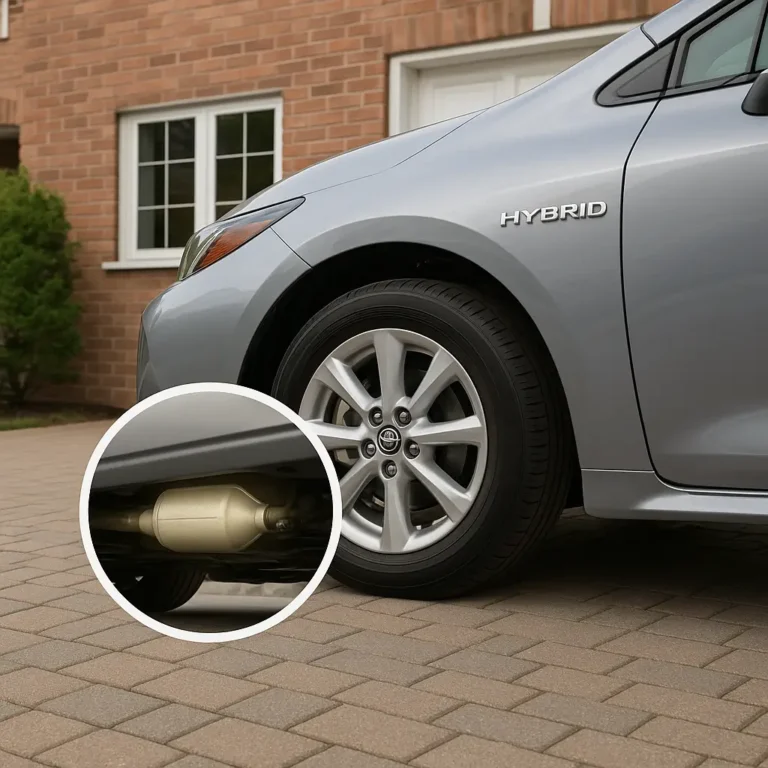
Most hybrids run two to four catalytic converters, and the Prius in particular is one of the most commonly stolen vehicles for its converters due to their high precious metal content.
Do Diesel Vehicles Use Catalytic Converters?
Yes — but the system works differently. Diesel exhaust requires a multi-stage treatment approach:
- Diesel Oxidation Catalyst (DOC) — oxidizes carbon monoxide and unburned hydrocarbons
- Diesel Particulate Filter (DPF) — traps soot and particulate matter
- Selective Catalytic Reduction (SCR) — uses Diesel Exhaust Fluid (DEF) to convert nitrogen oxides into harmless nitrogen and water
While diesel vehicles may have fewer traditional converters, their emissions systems are more expensive to maintain and repair, particularly the DPF, which requires periodic regeneration or replacement.
How to Find Out How Many Catalytic Converters Your Specific Car Has
Don’t guess — here’s how to confirm your vehicle’s exact setup:
- Check the owner’s manual — emissions equipment is usually listed in the specifications section
- Look up your VIN on sites like the NHTSA database or your manufacturer’s parts portal
- Read the emissions label — located under the hood on a sticker, it identifies whether your car is 49-state or CARB-compliant
- Inspect the exhaust system — look for metal canisters along the exhaust pipe between the engine and the muffler
- Ask a licensed mechanic — they can pull up your vehicle’s exhaust diagram in seconds
Signs a Catalytic Converter Is Failing (And Why It Matters)
Knowing how many you have is step one. Knowing when one is failing prevents the problem from cascading into a much costlier repair.
Common symptoms of a bad catalytic converter:
- Check Engine Light (P0420 or P0430 fault codes)
- Rotten egg or sulfur smell from the exhaust
- Sluggish acceleration or reduced engine power
- Failed emissions test
- Rattling noise under the vehicle (damaged internal substrate)
A failing converter doesn’t just hurt performance — it can damage oxygen sensors upstream and downstream, turning a $300 problem into a $900 one if ignored.
Does Having Multiple Converters Affect Performance or Fuel Economy?
Modern vehicles are engineered so that catalytic converters add negligible restriction to exhaust flow. In performance applications, high-flow catalytic converters replace restrictive OEM units while still maintaining emissions compliance.
What multiple converters do affect:
- Replacement costs — each failed unit is billed separately
- Theft risk — more converters means more precious metal, making your vehicle a bigger target
- Emissions complexity — more components mean more sensors, more failure points, and more diagnostic time
Final Takeaway
Most cars have one to four catalytic converters, with the exact number driven by engine layout, emissions regulations, and vehicle type. Modern cars — especially hybrids, V8 trucks, and luxury vehicles — routinely carry two to four units as standard equipment.
Knowing your vehicle’s exact configuration helps you:
- Budget accurately for repairs and replacements
- Choose the correct parts without overpaying or underspecifying
- Reduce theft risk by understanding your vehicle’s value to thieves
- Pass emissions tests the first time
If you’re unsure what your car has, a quick VIN lookup or five minutes with a mechanic will give you a clear answer — and potentially save you from a costly surprise.